
Tag Archives: manuscripts

Read, Hot and Digitized: Forms & Function – The Splendors of Global Book Making

Read, hot & digitized: Librarians and the digital scholarship they love — In this series, librarians from UTL’s Arts, Humanities and Global Studies Engagement Team briefly present, explore and critique existing examples of digital scholarship.  Our hope is that these monthly reviews will inspire critical reflection of and future creative contributions to the growing fields of digital scholarship.


On September 10, Princeton University Library unveiled a new digital and physical exhibition, titled “Forms and Function: The Splendors of Global Book Making.” The exhibition is a feast to anyone interested in book history, and especially those who want to learn about how the formats of a “book” varied through time and space. It is also a rare opportunity for the public to view some of the least known hidden gems in Princeton’s collections.

The exhibition includes manuscripts and printed books from Western, Islamic, East, South and Southeast Asian, and Mesoamerican cultures. There are seventy-four items on digital display, and they represent many materials for book making that may not be familiar to a contemporary and Western audience, including bark, textiles, shell, lacquer, and copper. The earliest produced book on display is an Egyptian clay cylinder from the 6th century BCE, while the latest is an Indian artistic book made with copper plates from 2020.

Three “traditions” of book formats are featured in the exhibition: the codex tradition, the East Asian tradition, and the pothī tradition.

The codices, defined in the exhibition as “single- or multi-gatherings of sheets folded inside each other, with texts on both sides, sewn together, and usually attached onto covers,” gradually replaced scrolls, and became the preferred format for early Christianity but later spread to Central and South Asia and was also adopted by Islamic and Hindu traditions. The exhibit includes an extremely rare early Coptic manuscript of Gospel of St. Matthew, and a palimpsest parchment on which the text was once erased to allow reuse.

Figure 1: Georgian palimpsest

Also included is a Chinese edition of  Missale Romanvm  produced by the Jesuits in 1670 which was printed with woodblock but bound in a European codex format.

The East Asian tradition, which included the Chinese, Japanese, and Korean cultures, demonstrates a wide range of mediums and materials to produce reading materials and extensive influence into other Eurasia regions. Among the bamboo slips and Dunhuang scrolls is an inner garment with over 700 “eight-legged” exemplary exam essays written on it, totaling more than half a million miniature characters.  

Figure 2. Pulinsidun daxue baguwen sichou chenyi

Another rare item on display is a reproduction of ink rubbings that the late-Qing statesman, Duanfang (端方, 1861–1911), made from Egyptian and Greek objects during his diplomatic missions in the early 1900s.  

Figure 3. Aiji wuqiannian guke

The pothī tradition, heavily influenced by the palm leaf, one of the earliest materials in the region used for writing texts, is no less diverse in terms of materials and formats that supported the texts. The exhibition features an earliest example of paper making from Nepal (1140), on which the popular Pañcarakṣā sūtra (Sūtra of the five protectresses) is written.  

Figure 4. Pañcarakșā sutra (Sutra of the five protectresses)

Coming after the palm leaves, later materials, such as birch bark, gold, and paper, mimicked its progenitor’s shape. The loose pages were usually stacked to make a bundle. With Brahmanism and Buddhism, the format spread across South and Southeast Asia and reached the Mongols and Manchus through Tibet.  

Figure 5. Coqbbertv (The emergence and migration of humankind)

Here is an example of a relatively understudied Dongba manuscript from the Naxi people, an ethnic minority living in China’s Yunnan province.

Beyond the main three themes, the exhibition also showcases some formats that different traditions share: single-sheet, scrolls, and accordion style. One of the highlights from this section is one of the earliest printed texts in the world, the Hyakumantō darani  from Nara-era Japan. 

Figure 6. Hyakumantō darani (A dhāraņī from inside a one-million-pagoda)

The work was commissioned by the court in 764. Printed Buddhist spells were inserted into mini pagodas. These short texts, also known as “mantras,” are verbal formulas and chants for various spiritual purposes. Currently, “tens of thousands of the pagodas and several thousand printed spells still exist.”

Last but not least, the exhibit shines light on even more materials that were used to serve as the media for texts. The hard surfaces of stone, metal, and bones were widely used across the globe. For example, a conch shell with Maya glyphs is on display in this section.

Figure 7. 1 Ajaw 3 Chakat (17 March, 761 CE)

The exhibition was curated by Dr. Martin Heijidra, Director of the East Asian Library at Princeton. The online version includes an interactive timeline and map, where viewers can click on the numbered titles of the items to go to their catalogue records, which has a brief but detailed description of the item and additional readings about the research on each of the items

Figure 8. A section of the interactive map

Online viewers can also download the PDF files of the accompanied catalogue and exhibition brochure. The digital exhibition not only provides an alternative for those who cannot see it in person, but it also gives it another form of life that will extend after the exhibition hall welcomes another array of objects.


Reference:

Martin Heijidra, curator (2025), Forms & Function: The Splendors of Global Book Making https://dpul.princeton.edu/global-book-forms

Tian, Tian. “Duanfang’s Egyptian Rubbings: The First Egyptian Collection in Late Imperial China.” Antiquity 99, no. 406 (2025): 1129–42. https://doi.org/10.15184/aqy.2025.10098.

Galambos, Imre. “The Chinese Pothi: A Missing Link in the History of the Chinese Book.” The Medieval History Journal 27, no. 1 (2024): 152–72. https://doi.org/10.1177/09719458241231669.

McDermott, Joseph Peter. A Social History of the Chinese Book: Books and Literati Culture in Late Imperial China. Hong Kong University Press, 2006.

Kornicki, Peter F. The Book in Japan: A Cultural History from the Beginnings to the Nineteenth Century. Brill, 1998.

Roper, Geoffrey. The History of the Book in the Middle East. Ashgate, 2013.

Benson Goes for Baroque

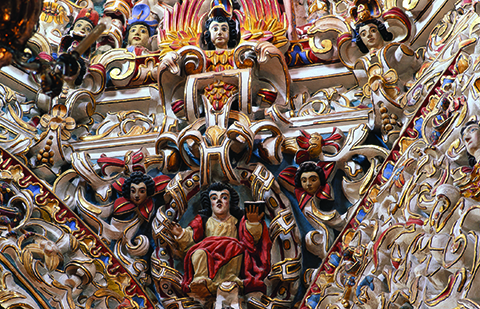
Iglesia de Santa María Tonantzintla, Puebla. Caroyln Brown.

The extravagance of the Baroque period in Spanish America is currently on display in an exhibition at the Benson Latin American Collection.

Inside the Baroque illuminates the splendor and diversity of Mexican arts and letters in the seventeenth and eighteenth centuries, and their enduring legacy. A selection of photographs by Carolyn Brown accompanies rare books and manuscripts from the Benson’s collections to present the Baroque period’s ornate style as it was manifested in the Spanish colonies of the Americas.

A complementary documentary film by Quin Mathews presents arresting views of Mexico’s baroque churches against a backdrop of life in modern-day Mexico. Mathews traveled with photographer Carolyn Brown in 2008, recording scenes of daily devotional and festive practice, and the film captures the centrality of local churches.
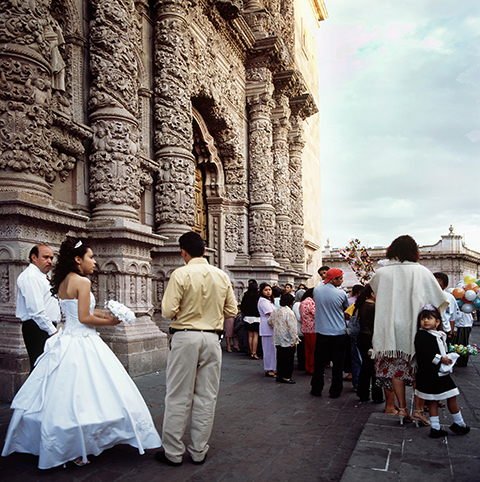
Wedding at Catedral de Zacatecas. Carolyn Brown.

Originating in 16th century Italy as a European Catholic response to the austerity of the Protestant Reformation, the Baroque style found purchase in the art, architecture and music of the period, and made its way to the Western Hemisphere by the end of the 1600s.
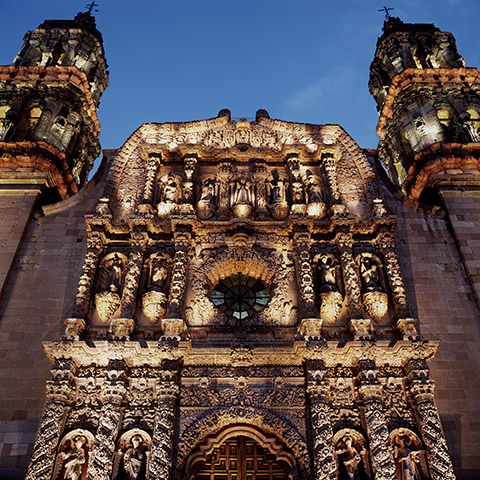
Catedral de Zacatecas at dusk. Carolyn Brown.

What made the movement particularly unique as it was expressed in the Americas was the influence of indigenous populations, craftsmanship and resources on the decorative style of religious structures that were erected as monuments to Spanish colonial power in the New World.

The exhibition will be on display through January 31, 2015, in the Benson Second Floor Exhibition Gallery, and is free and open to the public. Check the Benson website for a complete listing of hours.

Concurrently on view in the Benson’s first floor gallery is the 5th Annual LLILAS Benson Student Photography Exhibition featuring photography by University of Texas at Austin graduate and undergraduate students highlighting their expansive research, fieldwork, and volunteer activities within Latin American and U.S. Latina/o communities during the previous year.
 

Ransom Center Nabs Laureate

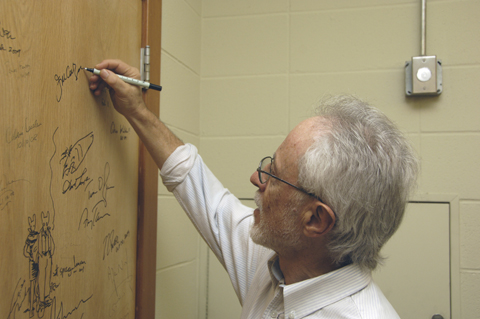
J. M. Coetzee signs the authors' door of the Ransom Center during a visit in May 2010. Photo by Pete Smith. Image courtesy of Harry Ransom Center.

One has to wonder how they do it.

The Harry Ransom Center has just announced a major addition to their stellar collection of contemporary writers, and yet another Nobel laureate, no less.

The archive of UT alumnus J.M. Coetzee is now part of the Ransom Center’s vast holdings of original manuscripts and source materials from major modern works of literature. The archive includes materials from all of Coetzee’s works, including his two Man Booker award-winning novels, Life & Times of Michael K (1983) and Disgrace (1999).

The South African Coetzee has a fifty-year history with the university, earning his Ph.D. in English, linguistics and Germanic languages in 1969. He’s kept close ties with UT, teaching at the Michener Center for Writers in 1995, and most recently, visiting campus last year to give a lecture as part of the Graduate School’s 1910 Society Lecture Series, which celebrated the 100th anniversary of the school.

Tennessee at College


Playbill for The Garden Players production of "Cairo, Shanghai, Bombay" by Bernice Dorothy Shapiro and Tom Williams, July 12, 1935. Courtesy of the Harry Ransom Center.

For once, we’re pretty happy that a lack of space has become an issue on campus.

Thanks in no small part to the ridiculously extensive Tennessee Williams holdings at the Harry Ransom Center, the Fine Arts Library has gotten the chance to host an overflow exhibit of materials related to the HRC’s massive homage to the Southern Gothic playwright, “Becoming Tennessee Williams.”

The companion exhibit at FAL, “Tennessee Williams, the College Years” features a limited number of items from Williams’s time in the academy – both at the University of Missouri, Columbia, and at the University of Iowa – including photos, correspondence, manuscripts and more.

The exhibition opens today and runs through July 31 in the Roberts Reading Room at FAL, where it can be viewed Monday through Thursday, 8 a.m. to 10 p.m., Friday, 8 a.m. to 5 p.m., and weekends from noon to 5 p.m.