
Tag Archives: rare books

Read, Hot and Digitized: Forms & Function – The Splendors of Global Book Making

Read, hot & digitized: Librarians and the digital scholarship they love — In this series, librarians from UTL’s Arts, Humanities and Global Studies Engagement Team briefly present, explore and critique existing examples of digital scholarship.  Our hope is that these monthly reviews will inspire critical reflection of and future creative contributions to the growing fields of digital scholarship.


On September 10, Princeton University Library unveiled a new digital and physical exhibition, titled “Forms and Function: The Splendors of Global Book Making.” The exhibition is a feast to anyone interested in book history, and especially those who want to learn about how the formats of a “book” varied through time and space. It is also a rare opportunity for the public to view some of the least known hidden gems in Princeton’s collections.

The exhibition includes manuscripts and printed books from Western, Islamic, East, South and Southeast Asian, and Mesoamerican cultures. There are seventy-four items on digital display, and they represent many materials for book making that may not be familiar to a contemporary and Western audience, including bark, textiles, shell, lacquer, and copper. The earliest produced book on display is an Egyptian clay cylinder from the 6th century BCE, while the latest is an Indian artistic book made with copper plates from 2020.

Three “traditions” of book formats are featured in the exhibition: the codex tradition, the East Asian tradition, and the pothī tradition.

The codices, defined in the exhibition as “single- or multi-gatherings of sheets folded inside each other, with texts on both sides, sewn together, and usually attached onto covers,” gradually replaced scrolls, and became the preferred format for early Christianity but later spread to Central and South Asia and was also adopted by Islamic and Hindu traditions. The exhibit includes an extremely rare early Coptic manuscript of Gospel of St. Matthew, and a palimpsest parchment on which the text was once erased to allow reuse.

Figure 1: Georgian palimpsest

Also included is a Chinese edition of  Missale Romanvm  produced by the Jesuits in 1670 which was printed with woodblock but bound in a European codex format.

The East Asian tradition, which included the Chinese, Japanese, and Korean cultures, demonstrates a wide range of mediums and materials to produce reading materials and extensive influence into other Eurasia regions. Among the bamboo slips and Dunhuang scrolls is an inner garment with over 700 “eight-legged” exemplary exam essays written on it, totaling more than half a million miniature characters.  

Figure 2. Pulinsidun daxue baguwen sichou chenyi

Another rare item on display is a reproduction of ink rubbings that the late-Qing statesman, Duanfang (端方, 1861–1911), made from Egyptian and Greek objects during his diplomatic missions in the early 1900s.  

Figure 3. Aiji wuqiannian guke

The pothī tradition, heavily influenced by the palm leaf, one of the earliest materials in the region used for writing texts, is no less diverse in terms of materials and formats that supported the texts. The exhibition features an earliest example of paper making from Nepal (1140), on which the popular Pañcarakṣā sūtra (Sūtra of the five protectresses) is written.  

Figure 4. Pañcarakșā sutra (Sutra of the five protectresses)

Coming after the palm leaves, later materials, such as birch bark, gold, and paper, mimicked its progenitor’s shape. The loose pages were usually stacked to make a bundle. With Brahmanism and Buddhism, the format spread across South and Southeast Asia and reached the Mongols and Manchus through Tibet.  

Figure 5. Coqbbertv (The emergence and migration of humankind)

Here is an example of a relatively understudied Dongba manuscript from the Naxi people, an ethnic minority living in China’s Yunnan province.

Beyond the main three themes, the exhibition also showcases some formats that different traditions share: single-sheet, scrolls, and accordion style. One of the highlights from this section is one of the earliest printed texts in the world, the Hyakumantō darani  from Nara-era Japan. 

Figure 6. Hyakumantō darani (A dhāraņī from inside a one-million-pagoda)

The work was commissioned by the court in 764. Printed Buddhist spells were inserted into mini pagodas. These short texts, also known as “mantras,” are verbal formulas and chants for various spiritual purposes. Currently, “tens of thousands of the pagodas and several thousand printed spells still exist.”

Last but not least, the exhibit shines light on even more materials that were used to serve as the media for texts. The hard surfaces of stone, metal, and bones were widely used across the globe. For example, a conch shell with Maya glyphs is on display in this section.

Figure 7. 1 Ajaw 3 Chakat (17 March, 761 CE)

The exhibition was curated by Dr. Martin Heijidra, Director of the East Asian Library at Princeton. The online version includes an interactive timeline and map, where viewers can click on the numbered titles of the items to go to their catalogue records, which has a brief but detailed description of the item and additional readings about the research on each of the items

Figure 8. A section of the interactive map

Online viewers can also download the PDF files of the accompanied catalogue and exhibition brochure. The digital exhibition not only provides an alternative for those who cannot see it in person, but it also gives it another form of life that will extend after the exhibition hall welcomes another array of objects.


Reference:

Martin Heijidra, curator (2025), Forms & Function: The Splendors of Global Book Making https://dpul.princeton.edu/global-book-forms

Tian, Tian. “Duanfang’s Egyptian Rubbings: The First Egyptian Collection in Late Imperial China.” Antiquity 99, no. 406 (2025): 1129–42. https://doi.org/10.15184/aqy.2025.10098.

Galambos, Imre. “The Chinese Pothi: A Missing Link in the History of the Chinese Book.” The Medieval History Journal 27, no. 1 (2024): 152–72. https://doi.org/10.1177/09719458241231669.

McDermott, Joseph Peter. A Social History of the Chinese Book: Books and Literati Culture in Late Imperial China. Hong Kong University Press, 2006.

Kornicki, Peter F. The Book in Japan: A Cultural History from the Beginnings to the Nineteenth Century. Brill, 1998.

Roper, Geoffrey. The History of the Book in the Middle East. Ashgate, 2013.

Down and Out in Lisbon and London: Antiquarian Books and Digital Humanities in Europe

Thanks to the generous support of the Center for European Studies and the UT Libraries, I was recently able to travel to London, England and Lisbon, Portugal.  On my trip, I had the chance to attend a scholarly conference, acquire unique materials to add to UTL’s collections, network with academics, vendors, and librarians, and purchase books for the UT Libraries’ collections.

A street in London lined with bookstores containing antiquarian and rare books.

My time in London was an invaluable opportunity to build stronger connections with an international cohort of colleagues. For example, I met with one of the UT Libraries’ vendors who I work with to procure rare materials on early twentieth century European politics. The vendor I met with, Carl Slienger, frequently supplies us with items not held by any other North American libraries, making the materials he sources very important for our distinctive holdings of pamphlets and other propagandistic literature, as well as antiquarian books that enhance our holdings of rare and unique European occult and spiritualist materials. I also met with a colleague at the British Library to discuss coding workflows and best practices for working with digital materials. Meeting with my colleague at the British Library was likewise very beneficial, as much of my work involving digital methodologies is focused on programming in Python and other languages, and I am currently supervising a project focused on using Python to automate digital archival workflows.

Ian standing outside of the British Library.
Ian outside of the British Library.

In Lisbon, I attended and presented at the The Alliance of Digital Humanities Organizations (ADHO) Digital Humanities 2025 conference.  My poster presentation focused on software packages I have written  in the Rust programming language to support multilingual computational approaches to linguistics and digital humanities. My poster highlighted three software packages: a package for performing lemmatization, a key natural language processing task, on text; a package for assessing the readability of a text containing a variety of algorithms to choose from; and a package to perform stylometric analysis on text. They were all built with multilingual support in mind, and as such are specifically designed to move outside of an Anglocentric paradigm often found in technologies for natural language processing and textual analysis, creating new opportunities for multilingual and non-English textual analysis and digital humanities. Beyond my own presentation, I was able to  attend talks on other digital research methodologies throughout the conference. Being able to attend talks by colleagues from all around the globe was both invigorating and rewarding, and an invaluable way to stay on top of the current research being done in the digital humanities. I also took the opportunity to acquire a small amount of zines while in Lisbon, adding to our collection of unique materials that we would not be able to purchase without undergoing a foreign acquisitions trip.

The poster session area at the DH 2025 conference in Lisbon.

This trip allowed me the opportunity to represent UT Austin internationally to a diverse group of colleagues, and I’m grateful that I was able to serve the Libraries in such a capacity. I look forward to building on our distinctive holdings and further expanding UT’s collections while continuing to work on using digital methodologies to enhance accessibility for research and open source software.

New Benson exhibition celebrates “El gaucho Martín Fierro”

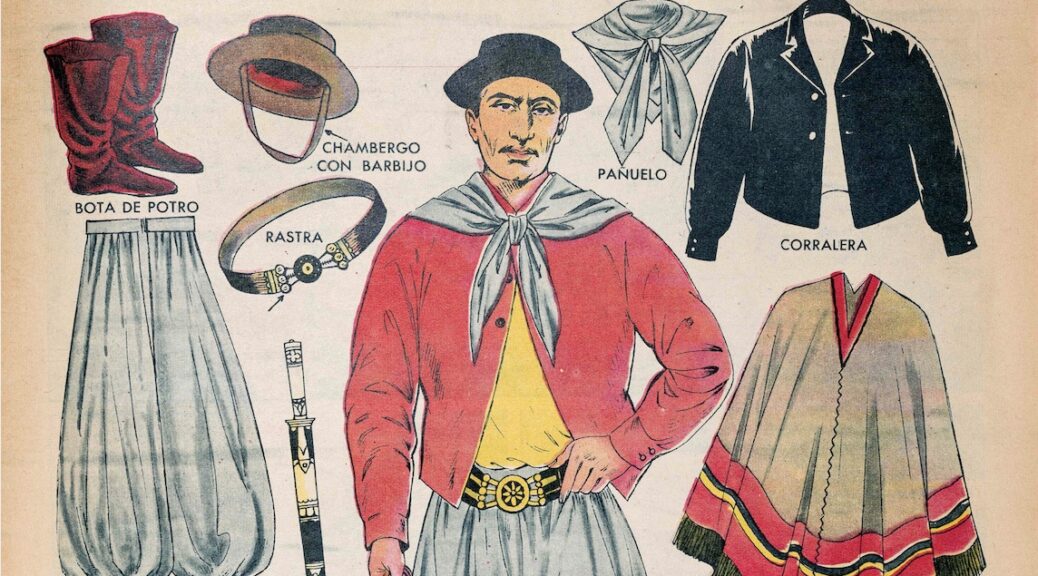
The Benson Latin American Collection recently inaugurated Martín Fierro: From Marginal Outlaw to National Symbol in the Rare Books Reading Room. Co-curated by Graduate Research Assistants Melissa Aslo de la Torre and Janette Núñez, this exhibition examines the Argentine epic poem El gaucho Martín Fierro and its legacy on the 150th anniversary of the poem’s publication.  Ryan Lynch sat down with Aslo de la Torre (MA) and Núñez (JN) to talk about their process. 


Related: Listen to “An Argentine Gaucho in Texas” on the Benson at 100 podcast. Escuchar este episodio en español.
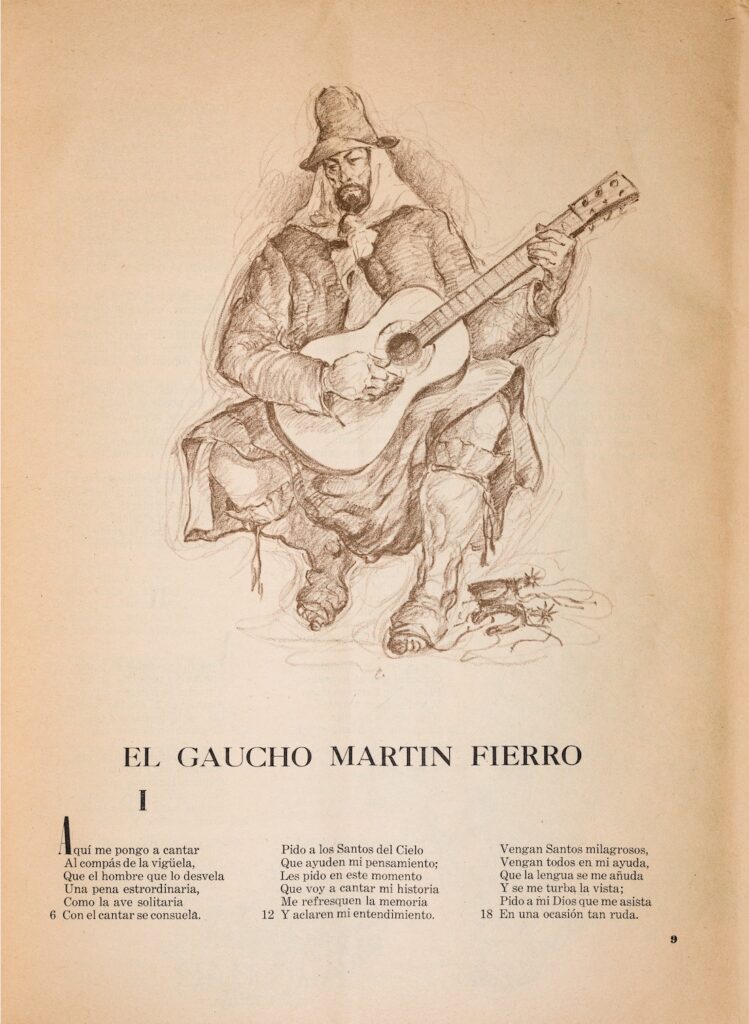

You write that the Benson has over 380 copies of El gaucho Martín Fierro and La vuelta de Martín Fierro. How did these books come to the Benson?  

JN: A big part of this collection came from two collections that the Benson purchased. One would be the Martínez Reales Gaucho library, purchased in 1961. That contained about 1500 books, pamphlets, and articles and literature of the Argentine cowboy, and more than 300 editions. The other one was the Simon Lucuix library, purchased in 1963. The collector had over 21,000 volumes on Uruguay and the Rio de la Plata area.  
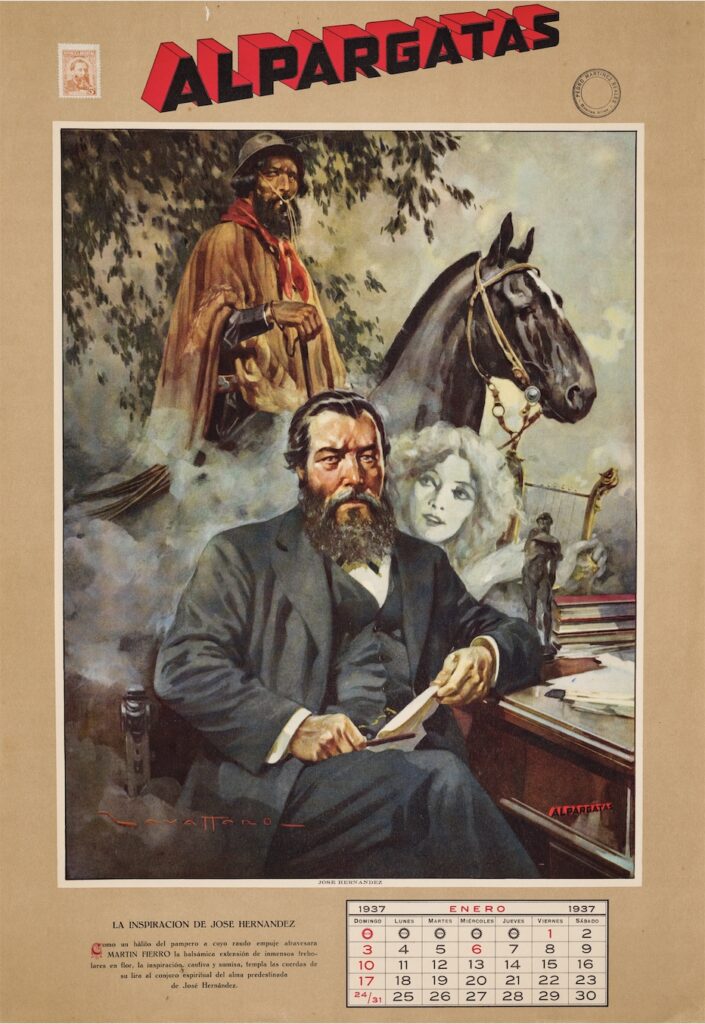
Portrait of author Jose Hernández from a 1937 Martín Fierro–themed calendar with illustrations by Mario Zavattaro, published by Argentine textile company Alpargatas.

Why do you think Martín Fierro has remained so popular?  

JN: The book was published nineteen years after the Argentine constitution of 1853. In that constitution, there was a government policy that encouraged European immigration as an effort to “clean ” races and also populate Argentina. The gaucho became a representation of this struggle of people who were feeling threatened and feeling the consequences of European immigration. 

MA: [Martín Fierro] was not the only poem that was written in the voice of a gaucho, but one of the differences is that this one really makes the gaucho the hero in a sort of tragic tale. It was therefore taken up by different groups of people as a symbol of someone who stands for freedom, someone who was oppressed by the government, sort of a hero of the people.  

It transitioned from mass popularity to being used by the literary elite to create a political national identity. And in that way, it got really inscribed into popular culture. There are images of a popular tango musician [Carlos Gardel] dressed as a gaucho. These two cultural products [tango and gauchos] are very, very different, but we can see as the gauchos diminished in number, they were used as a symbol of Argentine identity. 
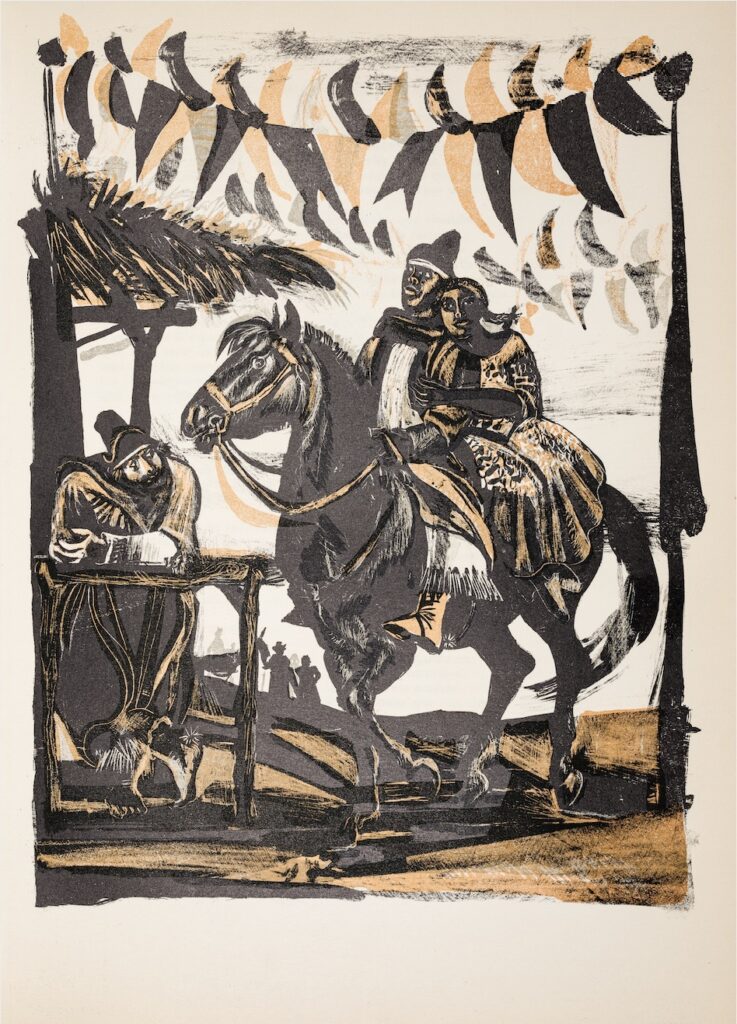
A color lithograph by Carlos Alonso depicting the unnamed Black characters who later face violence at the hands of Martín Fierro, from a 1960 edition of El gaucho Martín Fierro y La vuelta de Martín Fierro.

The exhibit focuses largely on the work’s legacy in Argentina. Can you talk about its influence outside of Argentina, such as in Brazil and Uruguay?  

MA: Gauchos existed in the Rio de la Plata area, it wasn’t just these artificial borders—it spanned the entire region. A gaucho in Argentina was very similar to a gaucho in Uruguay. 

One thing that I thought was interesting was that during the period when José Hernández was alive, there was a lot of political turmoil and he was exiled in Uruguay and Brazil; he started writing the poem in Brazil. There was this movement across these borders. 

Who should visit this exhibition?  

MA: Everyone! 
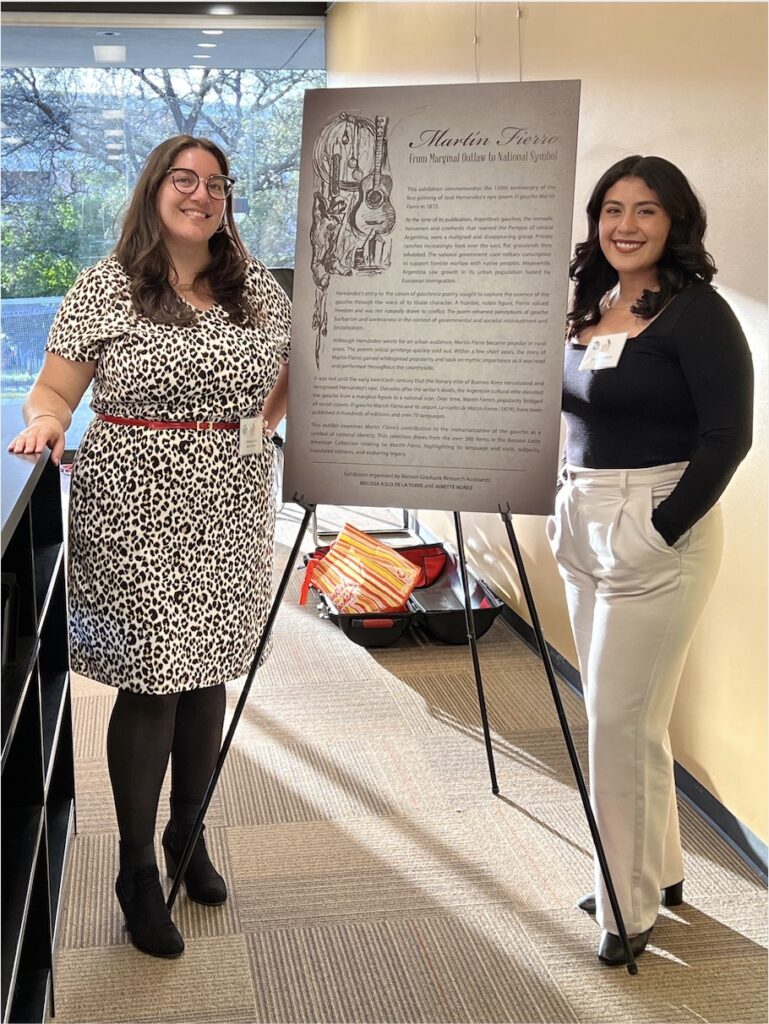
Exhibition curators Melissa Aslo de la Torre (left) and Janette Núñez.

What was the most interesting thing you learned in the course of doing this project?  

JN: For me, it was how heavily the government was involved in spreading the poem. When I found out that we had this poem was translated into over 70 languages, I had an idea that it was really popular internationally, but they were all published in Argentina. Something we’ve mentioned before is how it became so popular. I think it was really a true combination of both the mass public and the government. If either one wasn’t on board with this particular poem, I am not sure it would have been as popular as it was. 
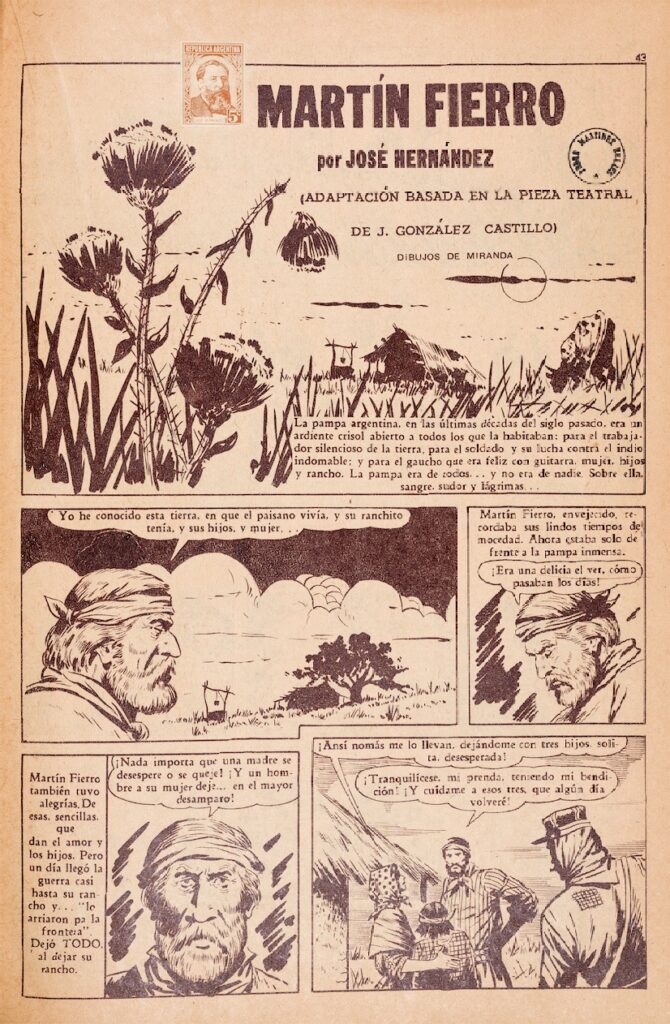
A comic strip adaptation based on a theatrical adaptation of Martín Fierro by José González Castillo from Intervalo, October 1960. Drawings by Miranda.

What is your favorite item in the exhibition?  

MA: One of my favorite items is a version that was written for a juvenile audience that is annotated. I appreciated the annotations because there’s so much gaucho language in the poem that was part of what made it successful, but part of what makes it difficult to understand even if you’re a Spanish speaker. It is interesting, one, because you can see how the poem is taught to young Argentines, and two, it makes it understandable for us as readers. 

We’ve talked a lot about how we chose to frame this and what we chose to focus on. All of it was driven by the holdings, but there are gaps. This is a very masculine, ideal image of this national identity. I would have loved to have more about who were the female subjects in the poem, how they were treated. 
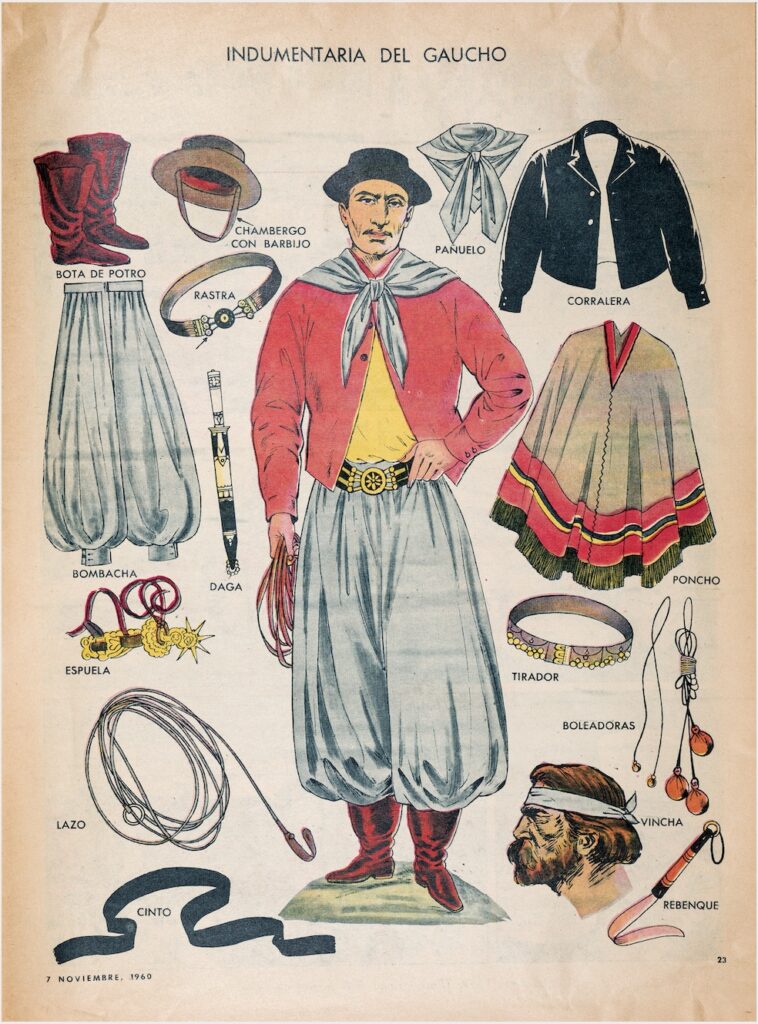
Do you think this experience will inform your careers in archives and libraries in any way? If so, how?  

MA: For me, I think it definitely will. This was my first time creating an exhibition and I really had to think about how there are so many access points to materials in archives and rare books.  

Previously, my work has been in providing reference, so I had to think about instruction in rare books and archives. How do I teach someone about these materials? How do I help tell a story? What kind of framing am I providing to this knowledge? That’s really one of the reasons that I chose this program and that I am interested in for my career—how is cultural knowledge framed by archives and museums, and what is it communicating to audiences? 

JN: I agree. Creating an exhibit is so different from providing reference. It’s putting it out there and then hoping it conveys the messages that we want it to convey. 

Also, it was my first [time] to put my experience of working in libraries and archives and my Latin American academic experience together. I do that when I do reference or processing, but putting an exhibition together is really thinking, what is my previous knowledge of Argentine history and politics? And what are my gaps, and how do I use my background to build on that? 

Another point is working collaboratively. We were able to bring both of our different experiences to put this one project together. Librarianship is very collaborative work—that is what they teach us at the iSchool. Being able to put that on something that wasn’t just a class project was a great experience as well. 


Ryan Lynch is Head of Special Collections and Senior Archivist at the Nettie Lee Benson Latin American Collection.

Melissa Aslo de la Torre is a master’s student at the School of Information at UT Austin (iSchool).

Janette Núñez is a dual-degree master’s student at LLILAS and the iSchool.