The University of Texas Libraries is collaborating with other local heritage institutions to highlight the contributions of Black historians to the study of antiquity.
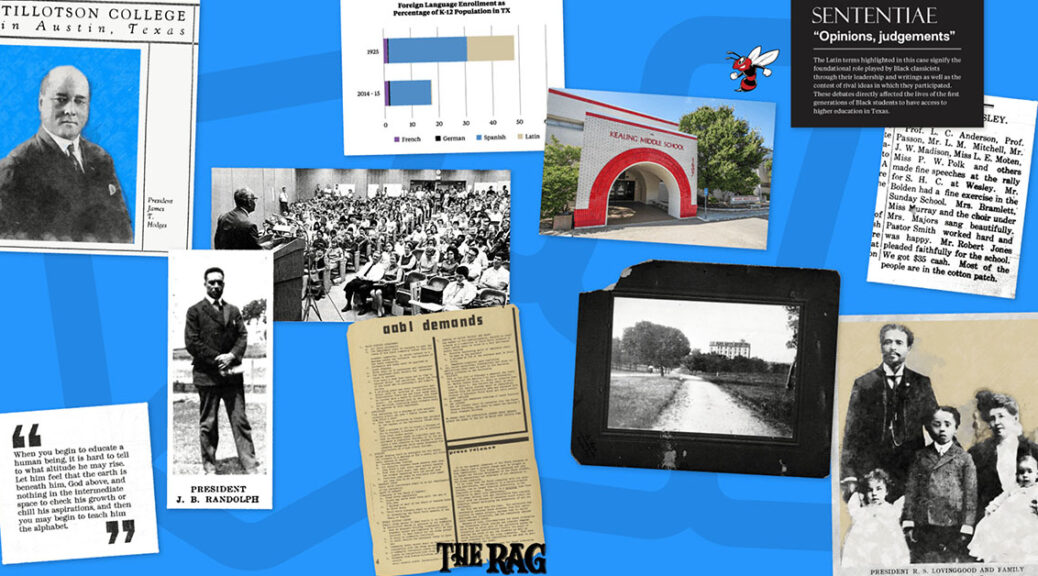
“Black Classicists in Texas” is a free public exhibition, celebrating the life and work of classicists of color in Austin and Central Texas. In 1900, Reuben Shannon Lovinggood, the Chair of the Greek and Latin Department at Wiley College in Marshall, Texas, made an impassioned argument against those who minimized the value of liberal education, especially Classics, for Black people. In the same year, Lovinggood became the first president of Samuel Huston College (now Huston-Tillotson University), and a pillar of the Austin Black community.
But he was not the only one.
The exhibition tells the story of Central Texas’ early educators of color and their passion for the study of antiquity. Explore images, archival materials, interviews, and current scholarship to find out more about Lovinggood, L.C. Anderson, H.T. Kealing and their vibrant community of scholars, students and public intellectuals. Learn about Classics and its place in historic debates on Black self-determination, and find out more about classical education in Austin today.
This exhibition is a collaboration between the Department of Classics at the University of Texas at Austin, University of Texas Libraries, the Black Diaspora Archive at the LLILAS Benson Latin American Studies and Collections, the Downs-Jones Library at Huston-Tillotson University, and the George Washington Carver Museum and Cultural Center.Visit the three exhibition sites at the Benson Collection at the University of Texas at Austin, Huston-Tillotson University, and the Carver Museum.
For more information on the exhibitions, including a self-guided tour and additional resources, visit the Black Classicists in Texas website at https://bcatx.org/.
“Black Classicists in Texas” will be on view through December 22, 2023.
Over the past year, Adriana Cásarez, U.S. Studies and African Studies Librarian, played a key role in coordinating the “Black Classicists in Texas” exhibition project, and worked in partnership with Libraries’ colleagues Rachel E. Winston, Dr. D Ryan Lynch, Dr. Lorraine J. Haricombe, Shiela Winchester, Mary Rader, and Aaron Choate.
Over the last decade, there has been a proliferation of initiatives by GLAM institutions (Galleries, Libraries, Archives and Museums) using Linked Open Data technologies to enhance access to their collections. From nation-wide collaborative campaigns, such as the Program for Cooperative Cataloging Wikidata Pilot, to paradigm-shifting implementations, such as the transition of the Library of Congress cataloging operations to a hybrid MARC and BIBFRAME environment, the growing availability of tools, ontologies and platforms are finally allowing cultural heritage institutions to explore the promises of linked data.
Librarians and archivists see the potential in Wikidata as a pragmatic solution for managing local authorities in a linked data environment; Wikidata is increasingly used for research and increasingly integrated into software applications, including Library Service Platforms like Alma/Primo.
The UT Linked Data Learning Group, an informal community of practice at The University of Texas at Austin, composed of professional staff working in archives and libraries, convenes monthly to address the need for pragmatic ways to integrate linked data into routine workflows. We collaborate to build knowledge, skills, and institutional support for linked data initiatives in our respective institutions.
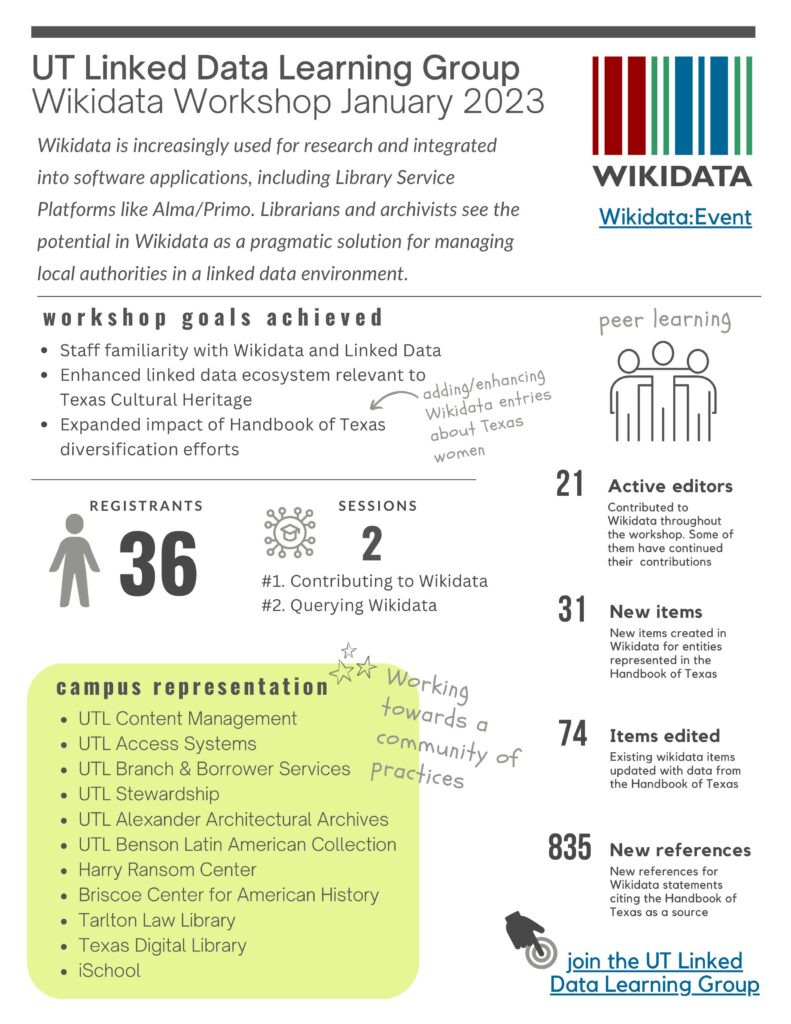
In 2022, group efforts focused on building knowledge and skills around Wikidata. Some members of the UT Linked Data Learning Group have been exploring and using Wikidata in various projects in recent years. This group aspired to leverage those members’ knowledge and skills to train other staff through a hands-on peer learning experience, with intentions to expand awareness and surface opportunities for integrating Wikidata into existing and future work. To that end, group members designed and delivered a 2-day virtual Wikidata Workshop on January 12-13, 2023.
Workshop Outcomes
Goals achieved:
Staff familiarity with Wikidata and Linked Data
Enhanced linked data ecosystem relevant to Texas Cultural Heritage
Expanded impact of Handbook of Texas diversification efforts (adding & enhancing Wikidata entries about Texas women)
Building a community of practice – campus representation among 36 registrants:
UT Libraries Content Management unit
UT Libraries Access Systems unit
UT Libraries Branch & Borrower Services unit
UT Libraries Stewardship department
UT Libraries Alexander Architectural Archives
UT Libraries Benson Latin American Collection
Harry Ransom Center
Briscoe Center for American History
Tarlton Law Library
Texas Digital Library
School of Information
Hands-on peer learning to build new skills:
21 active editors contributed to Wikidata throughout the workshop. Some continued with contributions after the workshop.
31 new items created in Wikidata for entries represented in the Handbook of Texas
74 existing Wikidata items updated with data from the Handbook of Texas
835 new references for Wikidata statements citing the Handbook of Texas as a source
Infographic of workshop outcomes
Individuals involved in designing and delivering the workshop: Melanie Cofield, Head of Access Systems, University of Texas Libraries (UTL); Brenna Edwards, Manager for Digital Archives, Harry Ransom Center; Paloma Graciani-Picardo, Metadata Librarian and Head, Printed & Published Media, Harry Ransom Center; Katie Pierce Meyer, Head of Architectural Collections, UTL; Michael Shensky, Head of Research Data Services, UTL; Yogita Sharma, Alexander Architectural Archives team member, UTL; and Elliot Williams, former DPLA Metadata Aggregation Outreach Coordinator for Texas Digital Library.
The Benson Latin American Collection at The University of Texas at Austin has made a significant oral history archive featuring voices of the Rio Grande Valley of South Texas and Northern Mexico available online through the Libraries’ Collections Portal.
University of Texas Rio Grande Valley history professor Manuel F. Medrano launched the Los del Valle Oral History Project in 1993 with the goal of collecting and preserving historical memories in the Rio Grande Valley, a region that has been historically underrepresented in archival and published research. Many of the original interviews were broadcast in edited form on local public access television. The collection of nearly 300 videos was transferred to the Benson Latin American Collection in 2015.
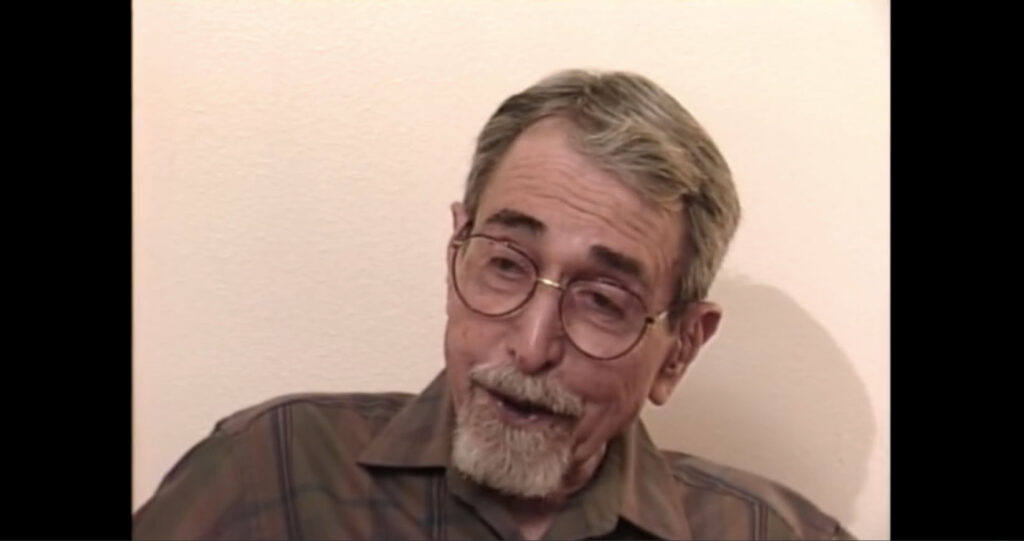
Raw footage of an interview with Dr. Américo Paredes, 1995. Dr. Paredes discusses how his parents came to Brownsville, his advice for writers, and the publication of his dissertation \With a Pistol in His Hand.
“By making the Los del Valle Oral History Project fully available online, the Benson highlights the immense intellectual and cultural contributions of the people of the lower Rio Grande Valley to the state of Texas,” says John Morán González, J. Frank Dobie Regents Professor of American and English Literature and former director of the university’s Center for Mexican American Studies. “Scholars, students, and the general public now have access to key figures and ideas that will surely enrich our understanding of this unique borderlands region.”
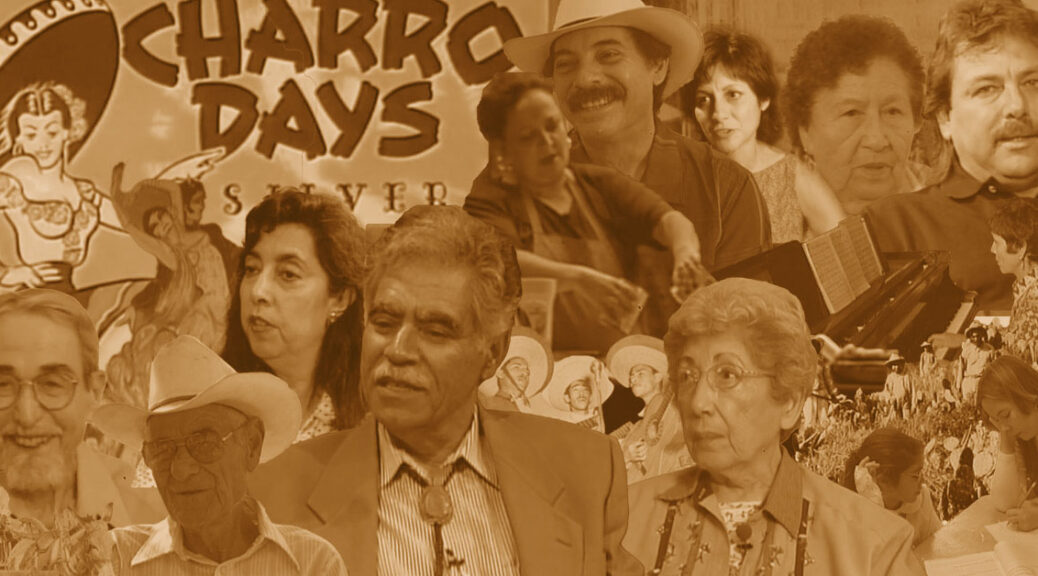
Los del Valle (Spanish for “those of the Valley”) is a term used to describe Mexican Americans who live in the rural South Texas, especially those in Hidalgo, Starr and Cameron Counties. These predominantly Mexican American communities, some of which predate the modern border between Mexico and the United States, represent a vibrant culture along this historically fluid border. Interviewees come from both sides of the modern border, and include writers Rolando Hinojosa-Smith, Carmen Tafolla and Oscar Cásares; scholar and folklorist Américo Paredes; educator Juliet Garcia; artist Carmen Lomas Garza; and accordionist Narciso Martínez. Other subjects include shrimp boat workers, Charro Days participants, World War II veterans and filmmaker Gregory Nava. These interviews cover a wide range of topics, from the early days of settlement in the region to the Chicano Movement and beyond.
An interview with Carmen Lomas Garza, a Chicana artist born in Kingsville, Texas, who talks about her art career. Lomas Garza talks about racial discrimination toward Mexican American families, and shares the influence and involvement of the Chicano movement in her life.
“Professor Manuel Medrano and his team have gifted us with an important resource that helps us understand the history of the Rio Grande Valley. By doing so, it places the RGV in the context of Texas and, more broadly, the U.S.,” says Maggie Rivas-Rodriguez, director of the Voces Oral History Center and the Center for Mexican American Studies.
“Oral history is key in documenting the perspective of the Latino community—too few Latinos/as will leave diaries, letters, and other records to a publicly accessible archive,” says Rivas-Rodriguez. “But even in the case of people like Américo Paredes, who did in fact leave his papers at the Benson, oral history provides context that would otherwise be unattainable.”
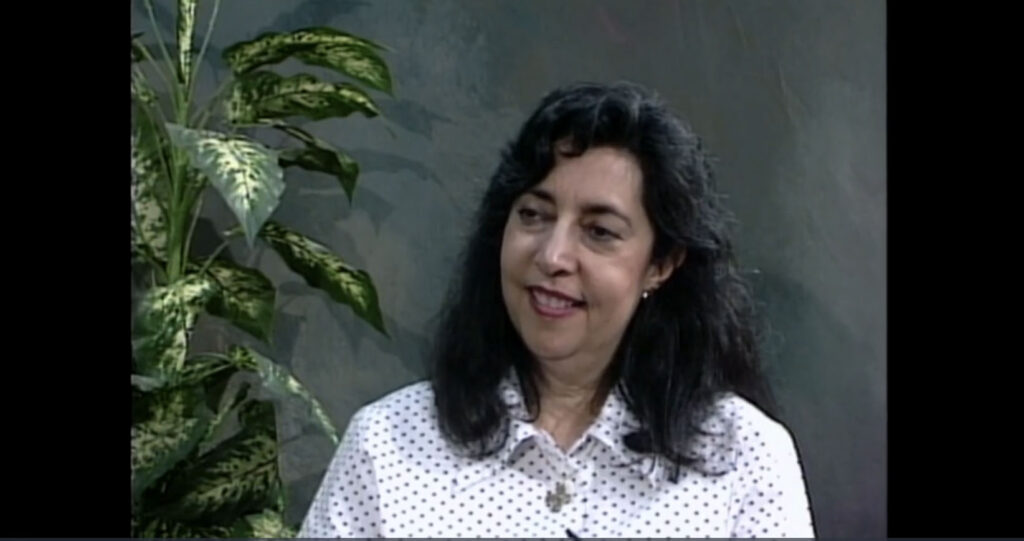
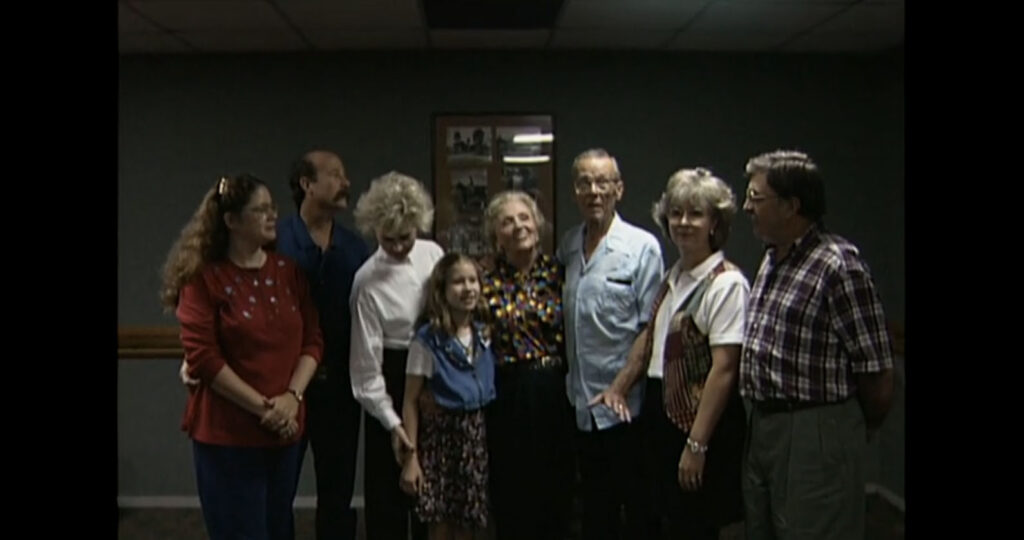
Interviews with Members of the 124th Cavalry Regiment at the 30th Annual Reunion. Interviews with members of the 124th Cavalry Regiment and their wives about their background, their memories of World War II, and what the reunion means to them.
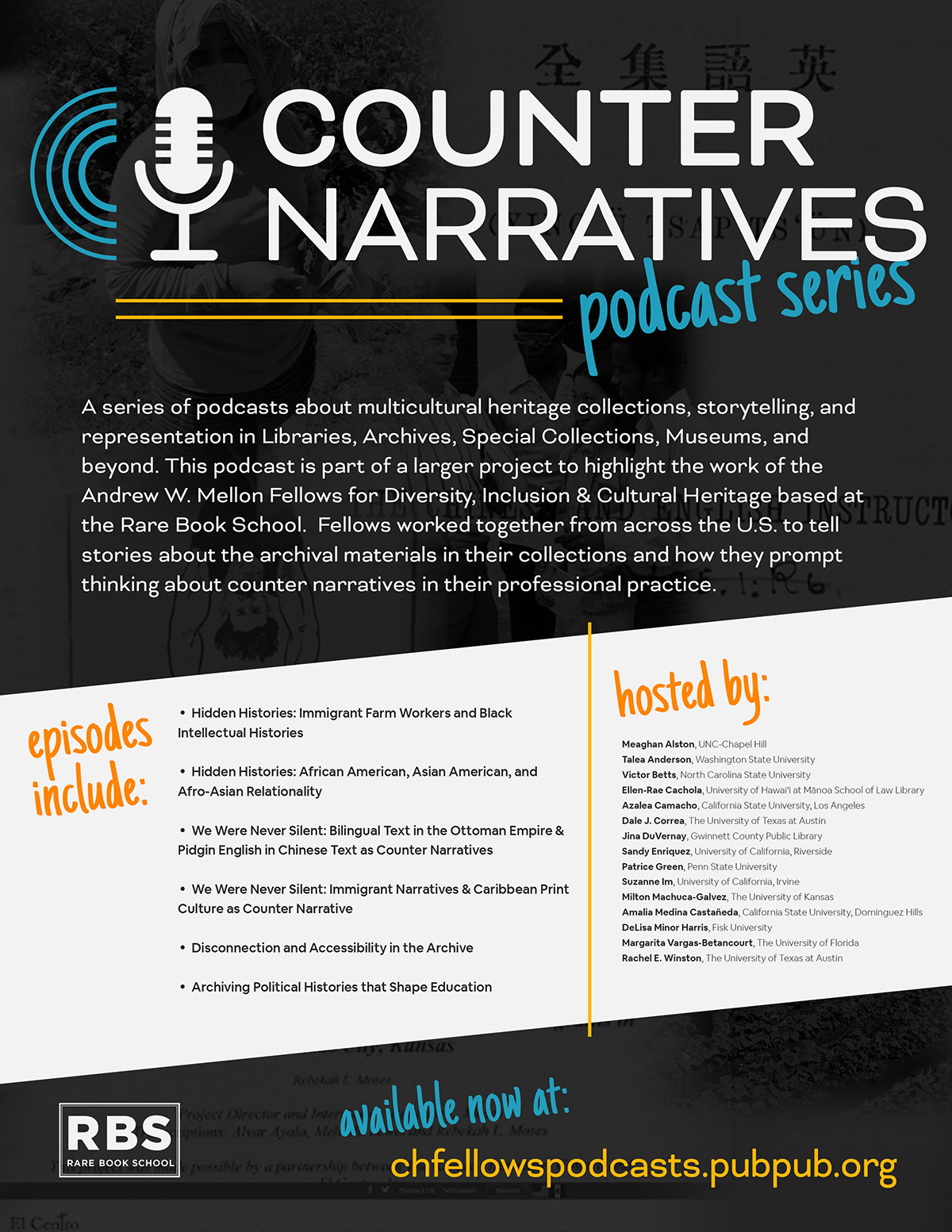
The Fellows, led by book historian Allie Alvis, worked together from across the U.S. to tell stories about the archival materials in their collections and how those stories can prompt thinking about counter narratives in professional practice.
The University of Texas Libraries’ Liaison for Middle Eastern Studies Dale Correa and Black Diaspora Archivist Rachel Winston are contributors to the project.
The podcast episodes, which are now all available, include:
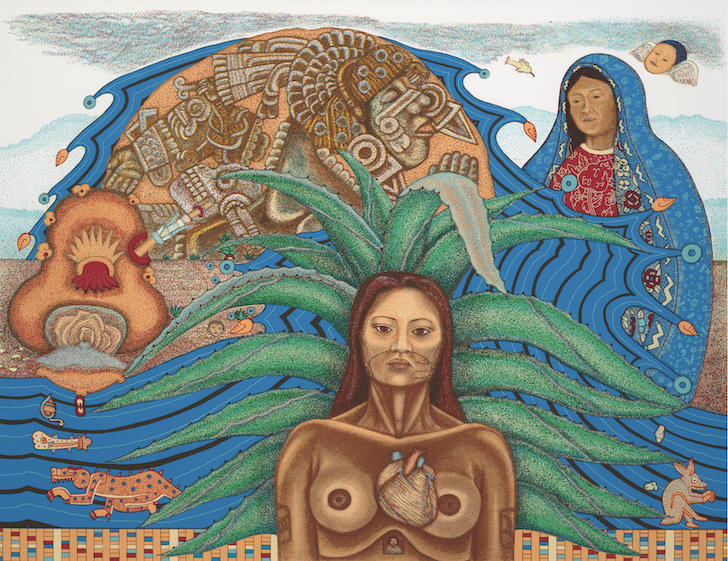
The Nettie Lee Benson Latin American Collection is proud to host the 21st Annual ¡A Viva Voz! Celebration of U.S. Latino/a/x Culture, featuring a conversation with Chicana/Tejana artist Santa Barraza.
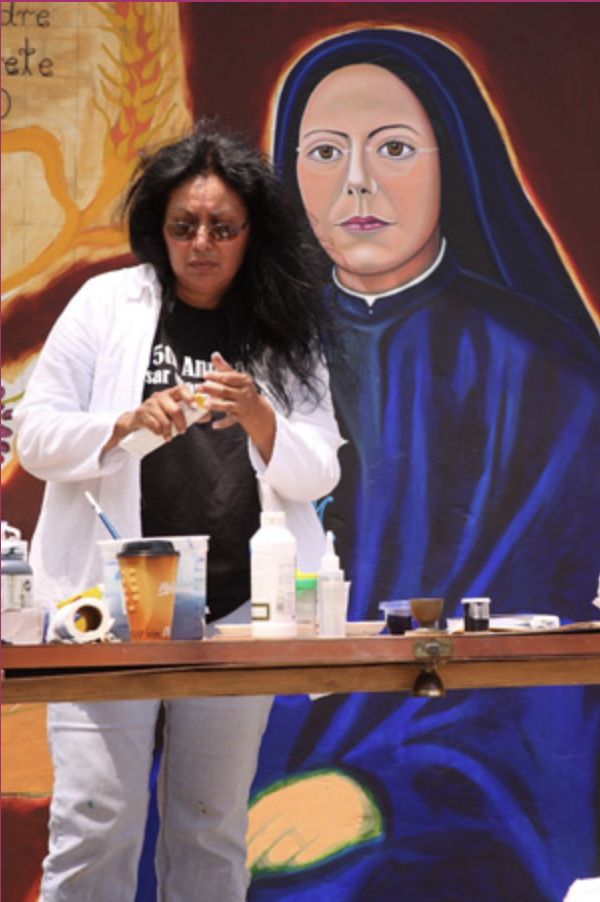
Santa Barraza, courtesy Juan Johnson Lopez
A native of Kingsville, Texas, Santa Barraza is a contemporary artist and founder of Barraza Fine Art, LLC, a gallery and studio committed to furthering the appreciation of the visual arts in the borderlands and among isolated, rural populations.
Barraza’s artwork is in the permanent collections of museums in Texas, California, and Maine; the Smithsonian Institution in Washington, DC; France; Germany; and Spain. Most recently, her work is on view in the art museums of Denver, Albuquerque, and San Antonio as part of Traitor, Survivor, Icon: The Legacy of La Malinche; the Mexic-Arte Museum in Austin for Chicano/a Art, Movimiento y Más en Austen, Tejas, 1960s–1980s; and for the Art in Embassies exhibition organized in Mexico City by the U.S. Department of State and U.S. Ambassador to Mexico Ken Salazar.
The ¡A Viva Voz! event also marks the opening of the exhibition Legacies of Nepantla: Artists Affirming Identity and Existence, curated by Maribel Falcón, the Benson’s U.S. Latina/o/x Studies Librarian. The exhibition showcases work that is part of the Benson’s archival holdings. It will be on view in the Benson’s Ann Hartness Reading Room through mid-August 2023.
“The exhibition showcases work from women whose myriad identities include Chicana, Native American, Tejana, and Latina, in addition to mothers, sisters, organizers, artists, activists, teachers, and students,” said Falcón. “Many of the featured artists are established as leaders in their communities and recognized as pillars of the Chicano/a art world, such as Santa Barraza, Carmen Lomas Garza, Patssi Valdez, Yreina D. Cervántez, Ester Hernandez, Irene Pérez, and Alma López.”
Due to an event at the Moody Center, parking is limited. We encourage attendees to use alternative forms of transportation. City of Austin street parking is available on Dean Keaton and on Red River north of Clyde Littlefield.
This event is free and open to the public. For more information, contact Susanna Sharpe.
Image: Cihuateteo con Coyolxauhqui y La Guadalupana, Santa Barraza, 1996
The Black Diaspora Archive (BDA) at The University of Texas at Austin documents the Black experience in the Americas and the Caribbean through the voices and stories of those who have championed the Black spaces that we use and benefit from today. Diaspora is defined as the “dispersion of any people from their original homeland,” and often when evoked with the Black experience in America, means the historical movement and displacement of Africans from their native homeland.
For the Black community in Austin, diaspora is a much more recent and closer-to-home event as its established Black communities are under threat of disappearing. Through the use of oral histories, the John S. and Drucie R. Chase Building Archive tells the story of the herding of the Black community into East Austin, the Black establishments and schools that grew during this time, and the subsequent displacement that has occurred in recent times. While much has changed for the Black community in East Austin, one building has stood in service of its community while enduring its own share of transformation.
Image used to herald the opening of the newly renovated Chase Building
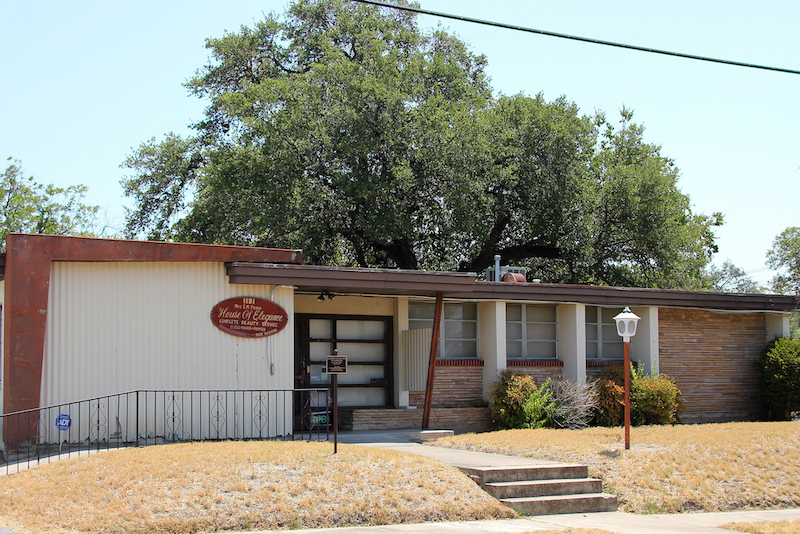
The building at 1191 Navasota Street in East Austin was built in 1952 to house what was then the Colored Teachers State Association of Texas (CTSAT). The CTSAT commissioned the building to serve as its headquarters and tapped John Saunders Chase as the architect to design the building. Chase was the first African American to graduate from the University of Texas at Austin’s School of Architecture and first to become a licensed architect in the state of Texas. The building that Chase designed would serve the CTSAT for 14 years before the association voluntarily dissolved in 1966 to merge with the Texas State Teachers Association. In 1968, the building was purchased by Dr. Ella Mae Pease and would become the House of Elegance. Now a beauty salon, the building served as a social hub for Black community in East Austin and a focal point for social events that Pease would facilitate. During its time as the House of Elegance, the building was added to the National Register of Historic Places.
The House of Elegance pictured at the end of its reign
After decades of service, the building was purchased in 2018 by the University of Texas at Austin and christened the John S. and Drucie R. Chase Building. Dr. Suchitra Gururaj, Assistant Vice President for Community and Economic Engagement, explains the decision to purchase the building:
“The idea for renovating the building came about in 2017, when House of Elegance owner, Pearl Cox, decided to sell the property. Former UT President Greg Fenves saw an opportunity to bring prominence to the university with the purchase of the first property designed by John S. Chase, the first Black/African American graduate of UT’s School of Architecture. When the purchase was made, we proposed that the space be repurposed as our next Center for Community Engagement (CCE) of the Division of Diversity and Community Engagement (DDCE). We consider the CCE to be the ‘front porch’ of our university, inviting community members and residents to connect with a large, decentralized, and often intimidating university that has not always welcomed people from diverse communities. In re-creating the Chase Building, we were not only able to celebrate Mr. and Mrs. Chase’s legacy but also to create a new life for the building that represented the intersection of diversity and community engagement. Like successful community engagement practice, our process of renovation was also collaborative, drawing on the mentorship of Donna Carter and relying on the expertise of Dorothy Fojtik and Nathan Goodman at UT Project Management and Construction Services. Over the period of the renovation, the project transformed from a simple university construction project into a true labor of love.”
Donna Carter, the first African American woman to become a licensed architect in Austin, led the effort to renovate the Chase Building. In 2022, the Chase Building reopened as the base for the Center of Community Engagement (CCE). This department within UT’s Division of Diversity for Community Engagement works to deploy university resources to foster connections with the community and meet community needs. In an effort to document the change that the Chase Building and East Austin have undergone over the years, the CCE began to conduct interviews with community members in 2019 and 2020 centering around the Robertson Hill neighborhood, the area that was home to the building. This project was advocated for by the Robertson Hill Neighborhood Association, which also suggested community members to interview for this project. The product of these interviews is the collection of oral histories and photographs that make up the John S. and Drucie R. Chase Building Archive. Housed in the BDA’s archival collection, these oral histories cover a range of topics including education, churches, and race and the City of Austin.
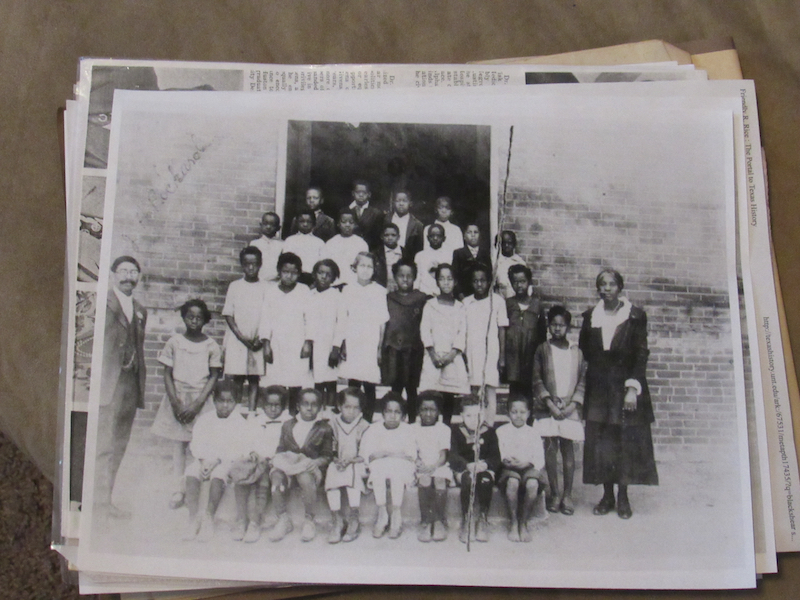
Archival photograph depicting a class from Blackshear Elementary
The Chase Building Archive consists of nine interviews with members of the East Austin community who have witnessed the change in the area. In her oral history, Mrs. Patricia Calhoun reminisces about growing up in the Robertson Hill neighborhood. She speaks about the streets that she grew up on that still remain today and the establishments in the community that do not. When talking about the importance of Black stories, Calhoun states, “Our stories are important to us because we’ve been here for generations, and yet the community is changing so rapidly that we could be erased without a thought.” This sentiment about the transformation of East Austin and the diminishing presence of its original community is observed throughout the collection. Mr. Clifton Vandyke Sr. jokingly remarks during his interview that “if we aren’t careful, this will be just like visiting a museum where people will come and say this is where African Americans used to live.” These quotes can be found on one of the four curated vignettes, “Storytelling and History,” that weave together common themes found throughout the assorted oral histories.
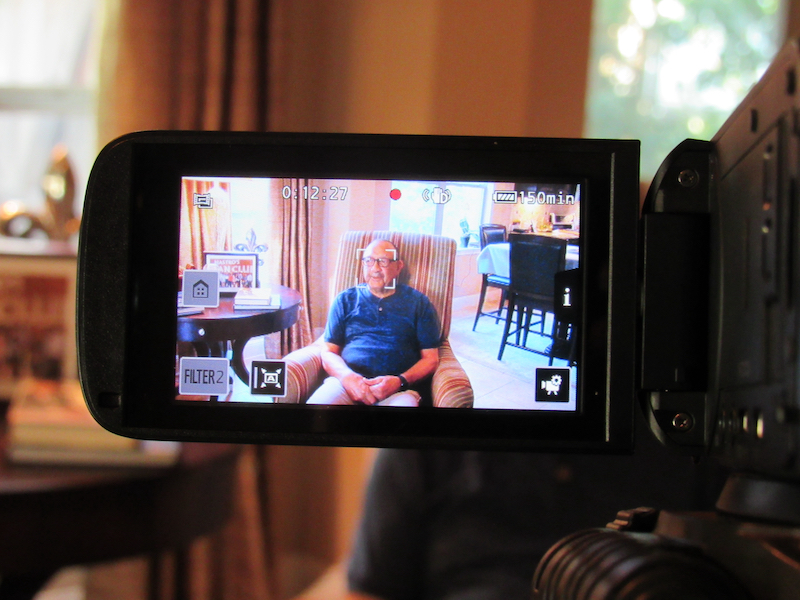
Mr. Clifton Vandyke Sr. seen through the camera lens during his oral history interview
Another vignette that can be found in the collection revolves around education and its importance with the community. Memories of attending schools like Blackshear Elementary School, Kealing Middle School, and Huston-Tillotson University testify to the many outlets available for education and the community’s pursuit of it. Ms. Lydia Moore spoke about the opportunity to choose which school she could attend after desegregation: “We had been told we would be the first group to have that opportunity to go anywhere we wanted to, but that we’d be ready. We need not be afraid. We need not feel inferior. But we would be ready.”
The thirst for education within the community sprouted from wanting not only to survive, but thrive in the world. The sentiment of wanting to thrive in East Austin is shared throughout the collection and can also be found in CCE’s efforts to collaborate with the community from the Chase Building. Stephanie Lang, Director for community-facing programs at CCE, expresses the aim of this collection: “As historic East Austin continues to change rapidly, the amazing legacy of these communities are at risk of erasure. This archive is but one of the many efforts being done to preserve these stories and provide a way for many generations to access, reflect on, and honor this important history.”
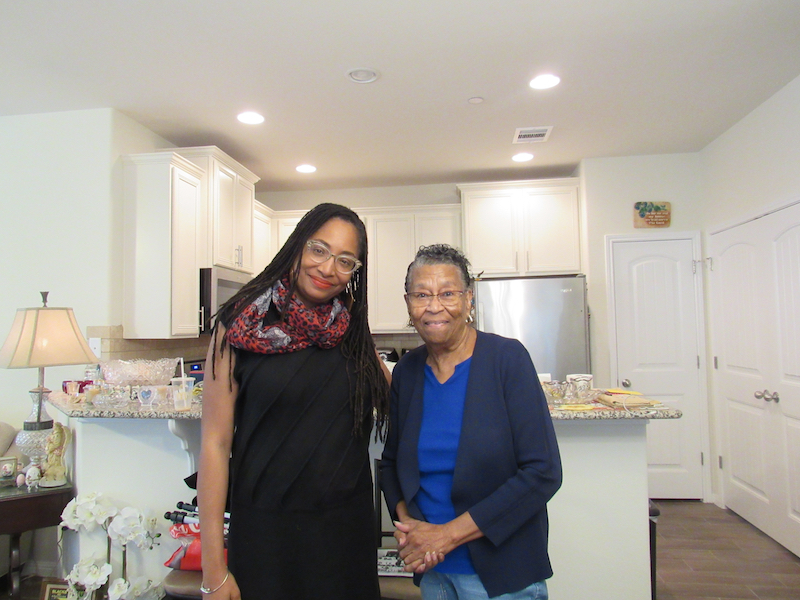
Mrs. Vonnye Rice Gardner (right) poses with Stephanie Lang, who worked as the interviewer for the project
Rachel Winston, Black Diaspora Archivist and steward of the BDA, states, “As we celebrate the legacies of John and Drucie Chase, the work of CCE, and the history of the Chase building, it is necessary to also recognize the local community that has made all of this possible. The interviews in this collection offer an incredible glimpse into the lives and experiences of Austinites from historic, Black East Austin.”
The John S. and Drucie R. Chase Building Archive is stewarded by the Black Diaspora Archive and can be accessed through a variety of avenues. The oral histories and photographs can be accessed online via the University of Texas Libraries Collections portal, here. The analog artifacts of the collection have been described in the collection’s TARO finding aid and can be requested in the Benson Latin American Collection’s rare books and manuscripts reading room. For more in-depth history about the Chase Building, visit CCE’s showcase on it and their series of videos centered around the building and its surrounding communities. Collections like the Chase Building Archive provide us the opportunity to learn how Black communities and spaces come about, and warn us about the diaspora that looms with their absence.
Jeremy Thompson is a Diversity Resident Librarian at the University of Texas Libraries.
Whit’s immersion in local music history and performance qualifies him as an authority as he explores and discovers some of the overlooked gems in this massive trove, and so in this occasional series, he’ll be presenting some of his noteworthy finds.
Onetime Band of Horses’ guitarist Tyler Ramsey takes a solo walkabout into deeply-wooded indie folk on The Valley Wind. From the Windham Hill-esque instrumental opener “Raven Shadow” through brooding ballad “1000 Blackbirds,” then on to the Laurel Canyon roots jangle of “Stay Gone” and the post-rock epic closer “All Night,” this collection draws you in to its warm campfire glow and unfolds its sad stories slowly. Ramsey’s reverb-drenched guitars and paper-thin tenor hearken Harvest-era Neil Young, but the songwriting is uniquely his introspective own. If tearjerker “Angel Band” doesn’t put a lump in your throat, check for a pulse.
This groovy compilation from under-the-radar hipster Italian label S.H.A.D.O. Records pays loving tribute to those bubbly analog organ sounds of the Hammond, Farfisa, etcetera, variety. Standout Euro and Euro-inspired tracks from Remington Super 60, Experimental Pop Band, Tony Goddess (Papas Fritas), and L’augmentation get the festive chamber pop party going, while Louise Philippe’s cover of Lennon/McCartney’s “I’m Only Sleeping” is simply divine. Don your finest threads, grab some wayfarers and a pack of Gauloises, and head towards that sunny Mediterranean beach in your mind.
Before all the buzz from their Better Call Saul theme song, U.K.’s garage/soul/rock trio Little Barrie thrilled club crowds and vinyl aficionados alike with their fuzzed-out retro tracks. The vibe is vintage – style and audio-wise – and this four song EP lays out a sampler platter of smoky bluesy treats. The slow and sly backstage funk of “Burned Out” has all the swagger needed for a proper British single, while “Mudsticks” comes across like Link Wray on a Death Valley peyote trip. And so as they say across the pond, “Bob’s your uncle.” What a fine introduction to their debut album We Are Little Barrie this is.
Greenville, Mississippi’s Eden Brent proudly carries forth the banner of boogie-woogie piano blues, all the while mixing in elements of jazz and classic pop. Schooled at the University of North Texas (and even more so on the road with legendary Abie “Boogaloo” Ames), Brent cooks down the musical ingredients of New Orleans, Memphis, and even a pinch of the great American songbook into her own greasy gumbo of groove. Recorded in the Crescent City (with ex-Meter George Porter on bass), the vibe leans more Mardi Gras than Beale Street, but it’s Brent’s Bessie Smith late-night lowdown voice that keeps it all rooted in an earthy Delta mood.
This critically-acclaimed string quartet put the art music world on notice with their debut album, Take the A Train. That Billy Strayhorn classic certainly shines as a title track, and even adds some needed levity to what is a fairly heavy collection. The bulk of the album is fleshed out by Wynton Marsalis’ brilliant avant-garde Creole-themed work “At the Octoroon Balls,” a modern American chamber music ode to Carnival culture. Other pieces foray into world music, further stretching the boundaries of fixed classical genres. On top of all this high level musicianship (and of even more importance), Harlem Quartet was founded by the Sphinx Foundation, a nonprofit promoting music education while working to build diversity in the field of classical music through outreach to underserved communities.
Harold Whit Williams is a Content Management Specialist in Music & Multimedia Resources. A celebrated poet, he is the longtime guitarist for the indie rock band Cotton Mather, and his solo projects include the lo-fi bedroom pop Daily Worker, as well as the retro funk GERVIN.
Read, hot & digitized: Librarians and the digital scholarship they love — In this new series, librarians from the UT Libraries Arts, Humanities and Global Studies Engagement Team briefly present, explore and critique existing examples of digital scholarship. Our hope is that these monthly reviews will inspire critical reflection of, and future creative contributions to, the growing fields of digital scholarship.
Working at the Nettie Lee Benson Latin American Collection since I began a career in librarianship, I have been fortunate to witness and sometimes participate in various facets of what goes into making the Benson the premiere Latin American collection in the world. The collection has many incomparable features, and depending on a researcher’s interest, they will know the Benson in unique ways from others. For instance, there are those that know the Benson because we hold the papers of Gloria Anzaldúa and Alicia Gaspar de Alba, two groundbreaking Chicana writers. Others will know it because of the Archive of Indigenous Languages of Latin America (AILLA), the digital archive that is a gateway to linguistic preservation and revitalization. Others will know it still because of our wonderful circulating collection, which includes journals, new publications, canonical works, children’s literature, etc. At the Benson we always say that if it exists and is tied to Latin American or US Latinx subject matter, we try to collect it.
One unsurprising aspect of the Benson is our dedication to documenting human rights initiatives. This happens across all of the ways that we do collecting, but I’m thinking specifically about the work that my colleague Theresa Polk and the Latin American Digital Initiatives team do on a daily basis, particularly working with post-custodial partners throughout Latin America to document local, often grassroots struggles.
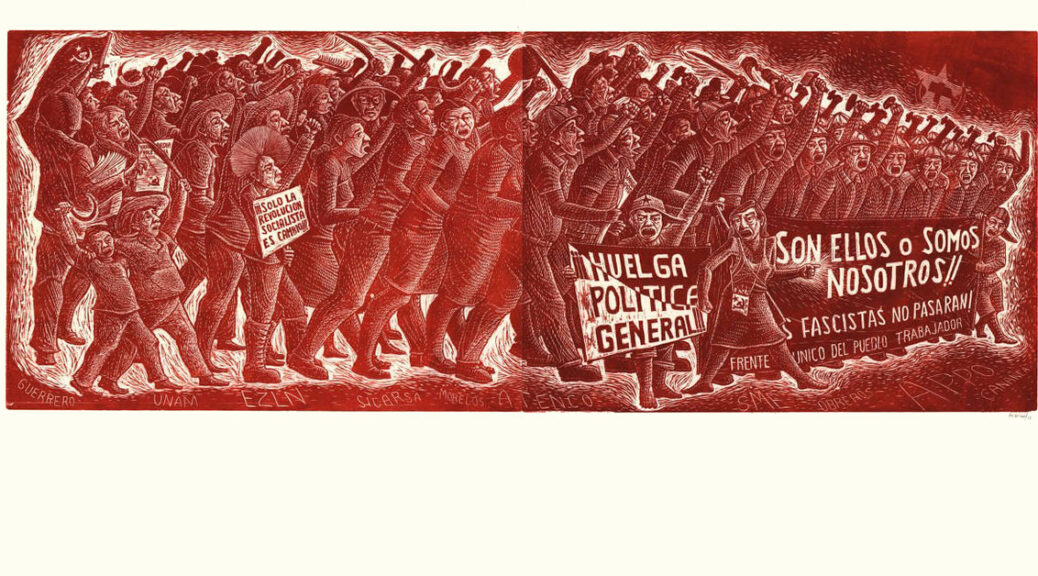
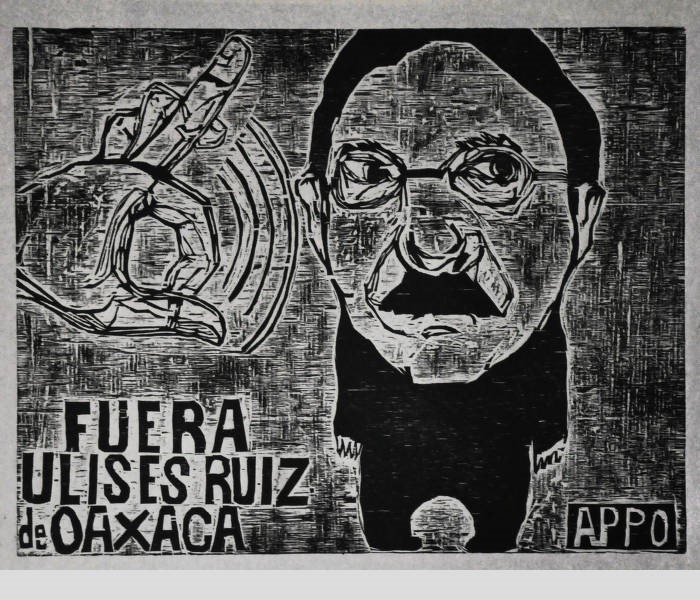
I couldn’t help but think of her work when I saw a noteworthy digital collection from the University of New Mexico’s esteemed Center for Southwest Research. The collection, “Asamblea de Artistas Revolucionarios de Oaxaca Pictorial Collection,” is described as a “collection of prints, posters, and mural stencils…created by a collective of young Mexican artists that formed during the state of Oaxaca’s 2006 teachers strike.” The strike lasted seven months and turned violent after police opened fire on non-violent protestors representing the teachers’ union. Eventually, various groups forced the police out of the city and set up an anarchist community for several months while unsuccessfully calling for the resignation of then-Oaxacan governor Ulises Ruiz Ortiz. The 127 artworks in this collection reflect this period through themes that include “land rights, political prisoners, government corruption, political violence, police brutality, violence against women, art exhibitions and the nationalization of agriculture and oil.”
Print depicting a caricaturized version of then-Governor Ulises Ruiz Ortiz.
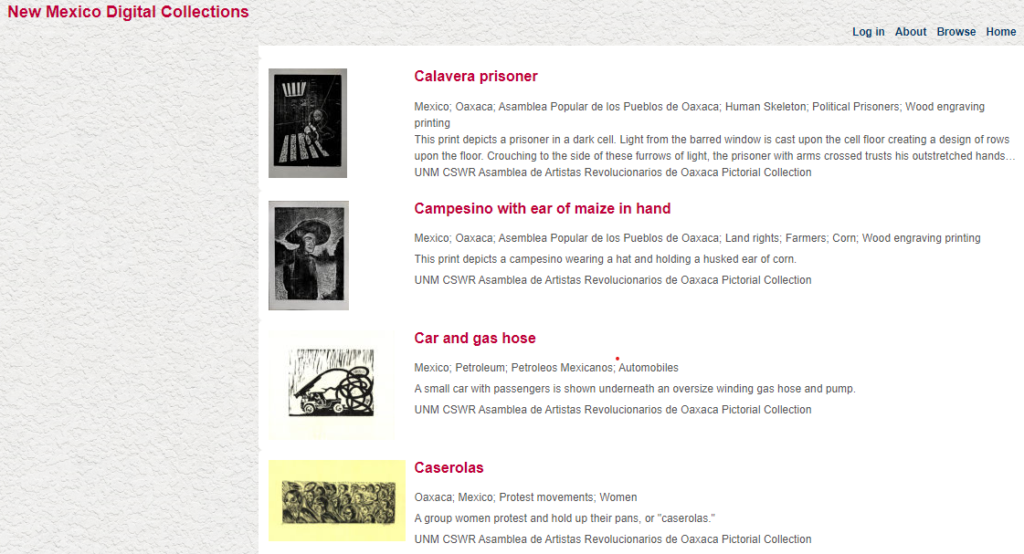
The artwork has been digitized and made available on the site using high-resolution scans. One of the strengths of the collection is that users can see a thumbnail and a brief, but useful description of the document, as shown below.
Then, users can click on each individual item for a larger image with richer metadata. Indeed, another strength of the collection is its metadata. While only in English, it contextualizes the image for a deeper understanding.
Another feature of the digital collection is that UNM’s Center for Southwest Research has worked with the Asamblea de Artistas Revolucionas de Oaxaca (ASARO) to archive their blogs and other digital-born materials using Archive-It. Having access to these blogs in a shared digitize space enhances the collection because it preserves ASARO’s voices on the struggle, using their words and their language. Like the metadata, this creates fuller meaning for researchers while fostering a relationship between ASARO and UNM.
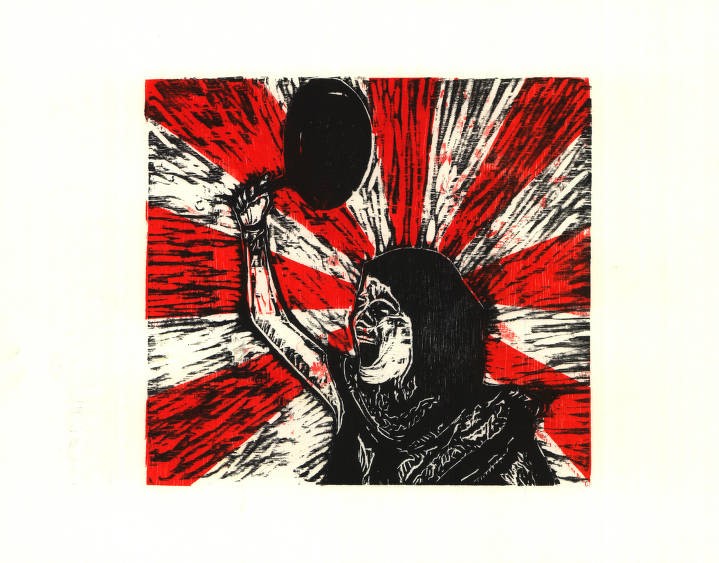
Women played an integral role in the uprising, often taking to the streets with pans.
This collection is useful to researchers and classes who are interested in understanding politics and local movements in twenty-first century Mexico. Like the Benson’s Latin American Digital Initiatives, the themes are so varied, making it a useful tool for classes doing interdisciplinary work, and particularly for scholars who are more visually-inclined. In any case, it is a welcome contribution to the study of human rights in Latin America, and a wonderful reminder of the work that libraries do in documenting and preserving historical moments.
Would you like to know more about the teachers’ strike? Check out the following resources we hold at UT Libraries.
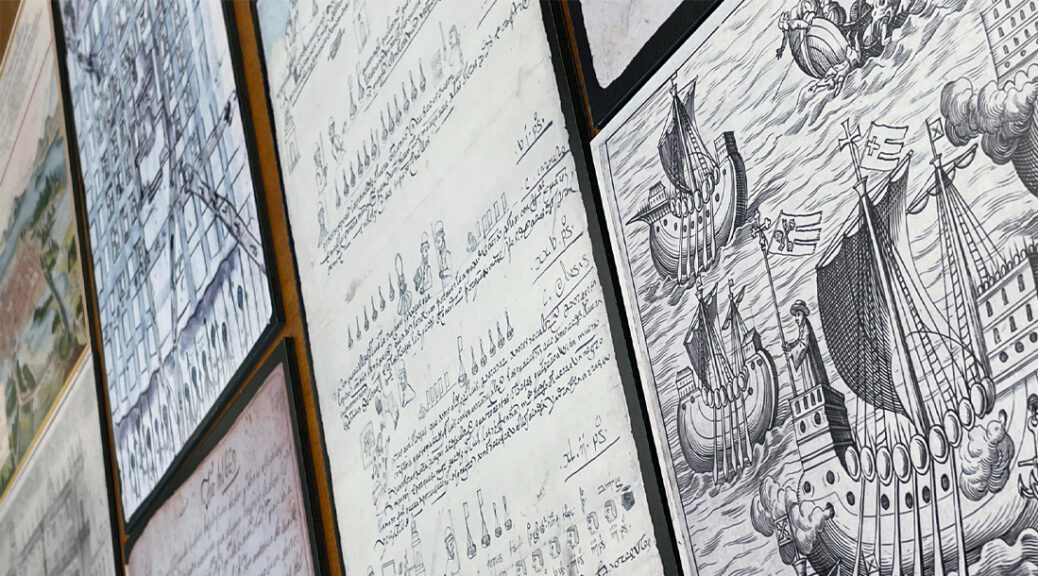
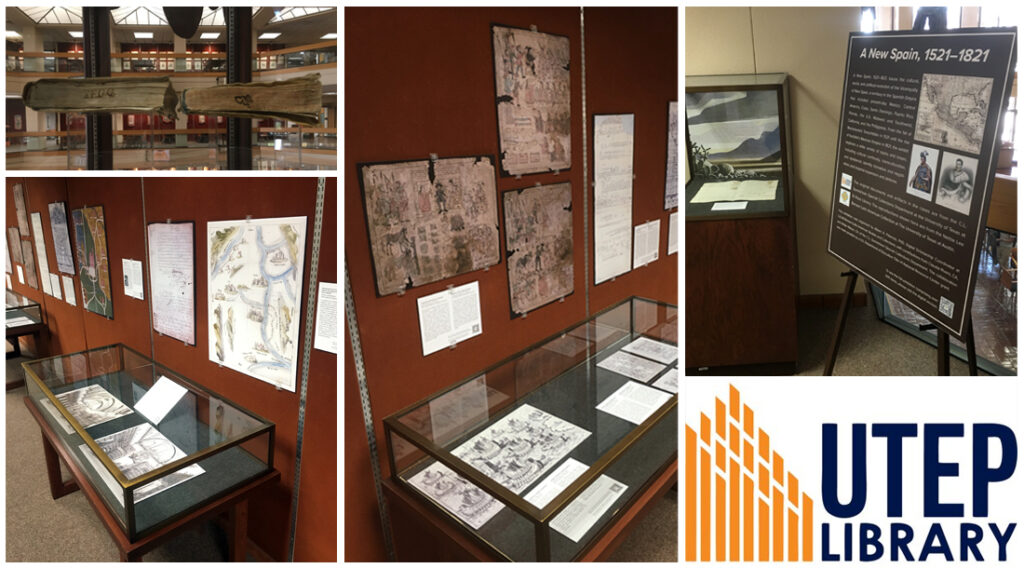
It was a doozy of a summer for the LLILAS Benson Digital Scholarship Office. Thanks to a Department of Education National Resource Center grant, we had the distinct opportunity to share some of the Benson Latin American Collection’s Spanish colonial treasures with a few communities outside of UT Austin. In a traveling exhibit titled A New Spain, 1521–1821, the reproduced materials demonstrated the cultural, social, and political evolution of colonial Mexico.
A New Spain exhibit at the University of Texas at El Paso Library, El Paso, Texas. The C.L. Sonnichsen Special Collections Department also showcased their Spanish colonial holdings in the exhibit.
We were fortunate to continue our longstanding partnership with the University of Texas at El Paso (UTEP). In collaboration with Claudia Rivers and Abbie Weiser at the C.L. Sonnichsen Special Collections Department, we put together an exhibit that highlighted Spanish colonial holdings from both libraries, providing both a hemispheric and local perspective. To broaden the impact of the collaborative effort, we also organized an accompanying series of workshops based on the materials for social studies teachers, colonialists, and archival professionals in the El Paso–Las Cruces (NM) region.
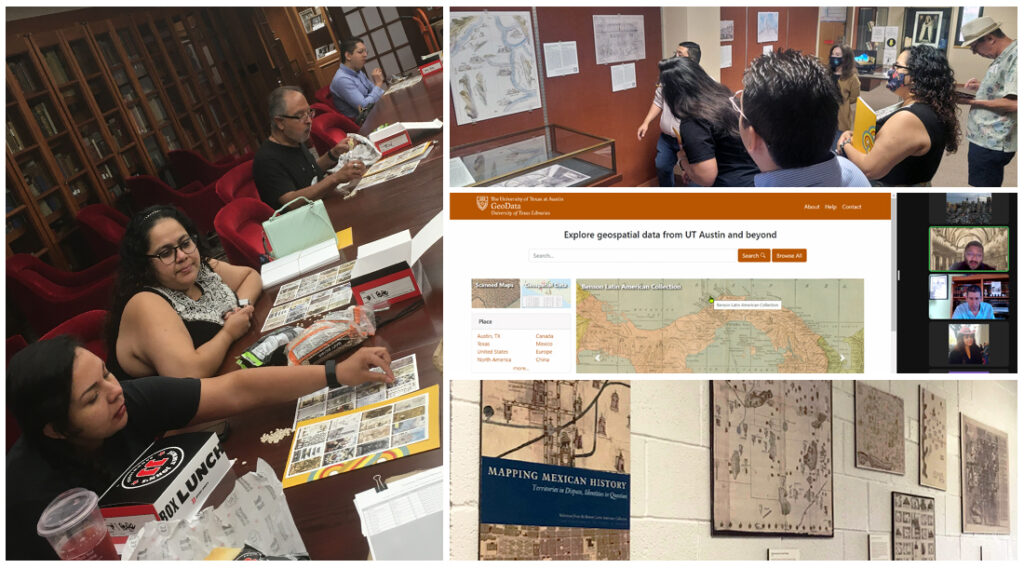
Clockwise from left: 1. Social studies teachers play a loteria game, or Mexican bingo, based on the exhibit’s items; 2. curator’s tour of A New Spain, 1521–1821 (photor: Aide Cardoza); 3. screenshot of online teacher workshop (photo: Tiffany Guridy); 4. Mapping Mexican History exhibit at Horizon High School, Horizon City, Texas (photo: Erika Ruelas).
We kicked off the programming with a two-day intensive training for teachers from El Paso and Clint independent school districts. The workshops started onsite at UTEP’s library with a curator’s tour, a lunchtime loteria game based on the exhibit, and an in-depth look at Indigenous and Spanish maps from a previous traveling exhibition, Mapping Mexican History. By the end of the day, teachers were able to take home the facsimile Mapping items, some of which are on display this fall at Horizon High School.
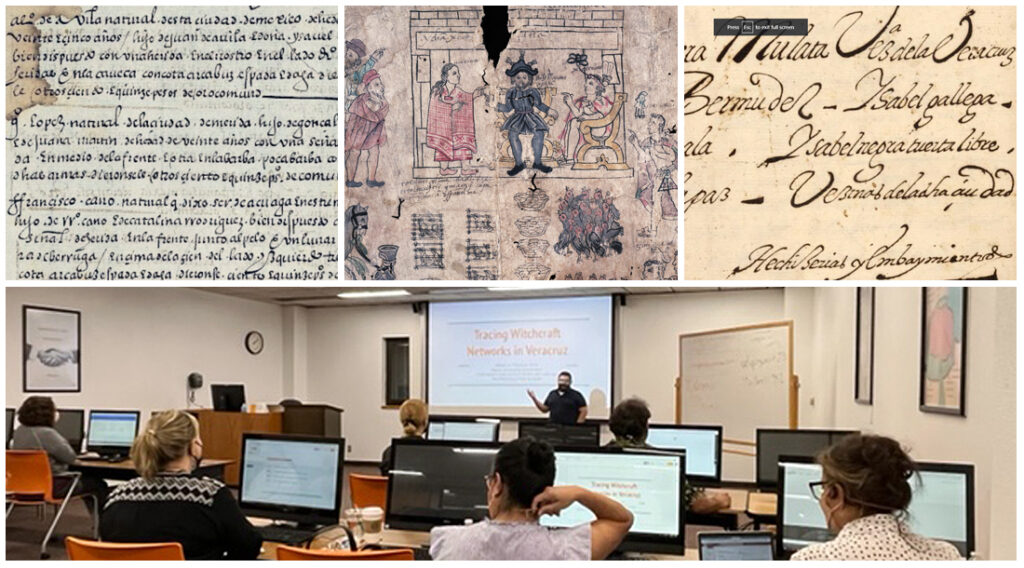
The second day of workshops went fully online. One of our 2022 Digital Scholarship Fellows, Dr. Diego Luis, shared an interactive simulation he designed based on an inquisitorial case archived at the Benson to teach about Afro-descendant colonial experiences. We then showcased lesson plans we developed with UT Austin’s Department of Curriculum and Instruction on the navigation of gender roles in New Spain. To wrap things up, we provided the teachers with a survey of digital resources at UT Austin and digital humanities tools they can use to teach about colonial Mexico in their class.
Clockwise from left: 1. Payroll of soldiers, 1575, Genaro García Manuscript Collection; 2. depiction of Tlaxcalteca ruler, Xicoténcatl, meeting with Hernan Cortés and Malintzin, circa 1530–1540, Ex-Stendahl Collection; 3. Inquisition case against Ana de Herrera for witchcraft, 1584, Genaro García Manuscript Collection; 4. “Tracing Witchcraft Networks in Veracruz” workshop (photo: Abbie Weiser).
On the final day, we shifted gears and led a series of digital scholarship workshops for local scholars. Students, faculty, and cultural heritage staff from the University of Texas at El Paso and New Mexico State University Library powered through three sessions that provided them with practical training in the visualization and analysis of Spanish colonial materials using various digital tools. Attendees learned to annotate various colonial texts and images, map the origins of New Spain’s soldiers, and visualize the networks of Afro-descendant hechiceras, or women casting incantations, in Veracruz.
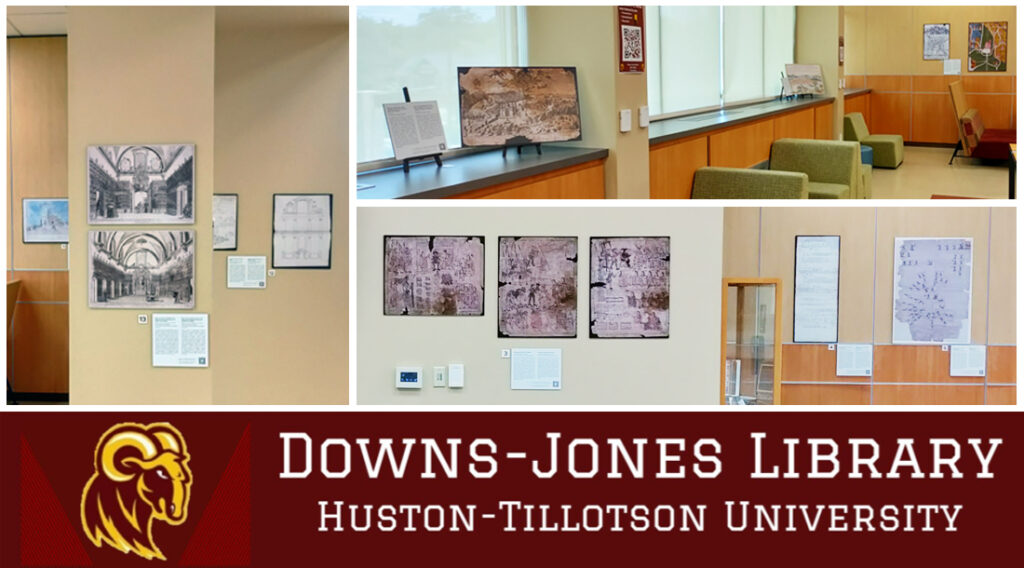
A New Spain exhibit at the Downs-Jones Library, Huston-Tillotson University, Austin, Texas (photo: Katie Ashton).
Upon our return to Austin, another one of our partners, Huston-Tillotson University, graciously agreed to host the traveling exhibit. Thanks to Technical Services & Systems Librarian Katie Ashton, the history of colonial Mexico we put together went up on the walls of the Downs-Jones Library, and will remain there throughout the fall. For those who are not able to visit either installation, you can explore the digital version through our UT Libraries Exhibits platform.
Acknowledgements
This initiative would not have been possible without the support of the following individuals and sponsorships:
C.L. Sonnichsen Special Collections Department, The University of Texas at El Paso
Claudia Rivers, Head
Abbie Weiser, Assistant Head
Huston-Tillotson University
Katie Ashton, Technical Services & Systems Librarian, Downs-Jones Library
Alaine Hutson, Associate Professor of History
Tufts University
Diego Javier Luis, Assistant Professor of History
Department of Curriculum and Instruction, College of Education, UT Austin
Michael Joseph, Doctoral student
Katie Pekarske, Master’s student
Cinthia Salinas, Department Chair & Associate Dean for Equity and Inclusive Excellence
UT Libraries
Brittany Centeno, Preservation Librarian
Katherine Thornton, Digital Asset Delivery Coordinator
LLILAS BensonLatin American Studies and Collections
Jac Erengil, Administrative Manager
Tiffany Guridy, previous Public Engagement Coordinator (special thanks)
Melissa Guy, Director, Benson Latin American Collection
Ryan Lynch, Head of Special Collections
Jennifer Mailloux, Graphic Designer (special thanks)
Adela Pineda Franco, LLILAS Director & Lozano Long Endowed Professor
Art historian Dr. Virginia E. Miller, a UT Austin alumna, has generously included support for LLILAS Benson in her estate. The bequest designates the creation of two program endowments: Virginia E. Miller Endowed Excellence Fund in Latin American Art Studies, to support the study of Latin American Art via LLILAS, and Virginia E. Miller Endowed Excellence Fund for the Benson Library, to support any function of the Benson Latin American Collection.
Dr. Miller completed her master’s in Latin American Studies from LLILAS (at the time, ILAS) in 1973, and earned her doctorate in Art History, also from UT, in 1981. An art historian who specializes in ancient Maya art, she is Associate Professor Emerita of Pre-Columbian and Native American Art in the Department of Art History at the University of Illinois, Chicago. Recently, Dr. Miller spoke to LLILAS Benson Communications Coordinator Susanna Sharpe, explaining how a young woman born in London, Ontario, Canada, made her way to Austin, Texas, to study Latin America.
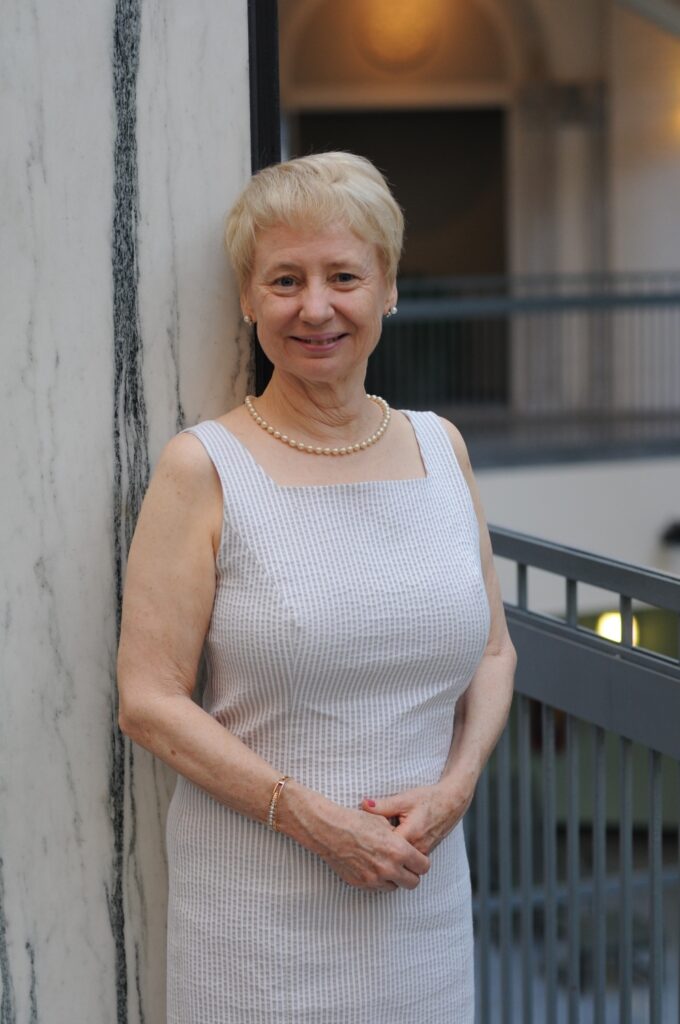
Photo courtesy Virginia Miller
“I was a French major [in college], but nobody was offering me a glamorous job in Paris when I graduated. But I got a chance to work for the YWCA in Mexico City, so I took it,” recalled Miller. “I had already spent a summer in South America by then.”
Driven by her interest in learning more about Latin America, her fluency in Spanish, and her desire to study and live someplace warm, Miller applied to a handful of master’s programs in the U.S. She knew very little about the programs she applied to. “Remember, this is before the internet.” A Latin American history professor she knew told her to choose UT Austin if she got in, so she did, although she admits the decision was rather random. “I hadn’t looked at a map,” Miller laughed, “I didn’t know where Austin was; I just knew it was in Texas. I couldn’t understand anybody at all for the first few days!”
It was during an art history seminar during her first semester that Miller began to develop an interest in the field that would become the focus of her career. Once she began the PhD program in art history, things gradually began to fall into place and her focus zeroed in on pre-Columbian and then specifically ancient Maya art.
Miller remarked on witnessing her own students’ reactions to this material. “A lot of my students were just astonished to learn about [pre-Columbian art]. Even the art history majors. I got a lot of converts from modern and Renaissance art, especially at the master’s level. The best part of teaching was the students’ discovery of these cultures.”
Although she spent most of her career teaching at UIC, Miller also taught at Oberlin College and Northwestern University. As a Fulbright scholar, she taught in both Guatemala and Mexico. She also took a brief break from teaching to join the Foreign Service, working in the consular office of the American embassy in Madrid.
Miller’s memories of UT and of Austin are joyful and positive, and it is clear that the Institute of Latin American Studies and the Benson Collection were a hub for much of her engagement here.
“UT was really foundational to me—to my professional career, but also to me personally. I really enjoyed my time in Austin. It was wonderful having that fantastic library. There were so many events that had a Latin American focus. There were so many faculty, even in areas I didn’t do, like geography and history, that you had this wonderful climate.”
Recalling the Benson, she said, “I loved the library. It had every publication. It was amazing. I mean, I would be researching pre-Columbian art in say, Bolivia, and I would find a journal that had two issues published in La Paz in the twenties [laughs] and it would be in the library! I was completely spoiled. Even Dumbarton Oaks in Washington does not match it. I was in the library a lot. Partly to work, partly to hang out with my friends, and partly because back then you browsed the stacks a lot. . . . I would browse the stacks endlessly to find interesting material on a wide range of subjects. It was the amplitude of the library and the accessibility of the material . . . it was just a very good atmosphere there.”
The inevitable question arose: Did she cross paths with the revered (and sometimes feared) head librarian Nettie Lee Benson? “Oh yeah. She terrified me! [laughs] She was in charge! I also knew Laura Gutiérrez-Witt, and David Block was a close friend of mine in graduate school.” (The beloved Gutiérrez-Witt and the late Block are former head librarians at the Benson.)
The Latin American Studies master’s degree offered Miller the freedom she needed to explore a wide and diverse field. “I was fascinated that when I arrived, I went to see my adviser because I didn’t know what to take, and he told me I could take anything,” she said.
It is clear that Dr. Miller’s gift is her way of giving back to a place that helped shape her and enriched her life.
“I had a lot of fun there. I know that’s not academic, but I really enjoyed my time. Austin is a wonderful memory to me.”